
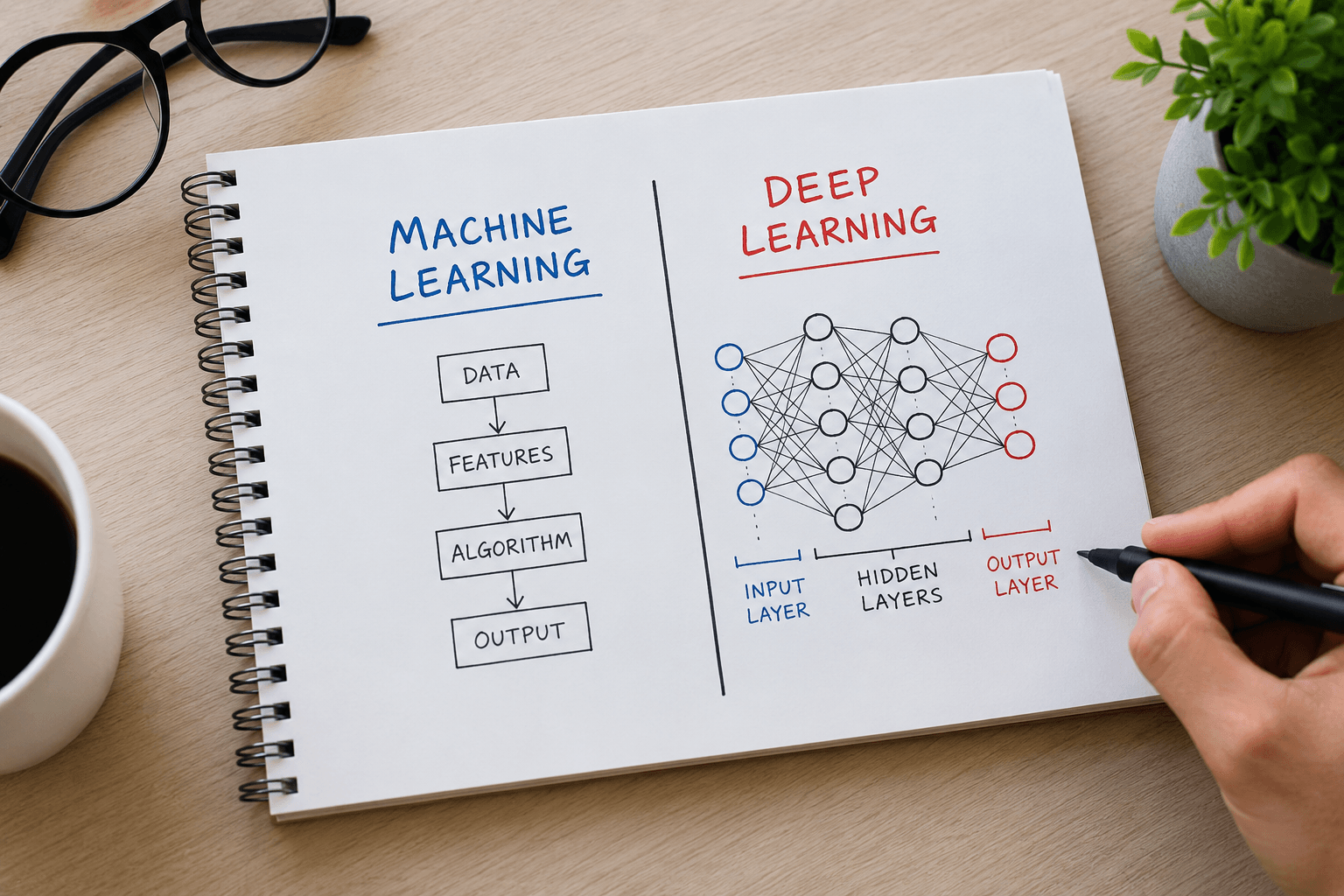
Artificial intelligence has become a valued team member of any modern business, but two terms continue to confuse professionals and beginners alike: Machine Learning (ML) and Deep Learning (DL). Although they are closely related, they solve problems differently and require different levels of data, computing power, and expertise.
Machine Learning enables computers to learn patterns from structured data using algorithms such as Decision Trees, Random Forests, and Support Vector Machines. Deep Learning, a specialized subset of Machine Learning, uses multi-layered artificial neural networks to automatically learn complex representations from massive datasets, making it ideal for applications like computer vision, speech recognition, and generative AI.
Understanding the difference is important for data engineers, machine learning engineers, software developers, AI practitioners, and business leaders making technology decisions.
Table of Contents
What Is Machine Learning?
Machine Learning is a branch of Artificial Intelligence that enables computers to learn patterns from historical data without being explicitly programmed for every scenario.
Instead of writing fixed rules, developers train algorithms using datasets. The model identifies relationships between variables and uses those patterns to make predictions on new data.
For example:
| Input | Machine Learning Prediction |
|---|---|
| Customer purchase history | Will the customer churn? |
| House features | Estimated selling price |
| Email content | Spam or legitimate |
| Credit application | Loan approval probability |
| Patient medical records | Disease prediction |
Machine Learning relies heavily on feature engineering, statistical models, and mathematical optimisation.
Most enterprise AI systems today still rely on traditional Machine Learning because it offers an excellent balance between accuracy, explainability, scalability, and computational efficiency.
Types of Machine Learning
Machine Learning is generally divided into four categories.
Supervised Learning
The algorithm learns from labelled datasets containing both inputs and expected outputs.
Common applications include:
- Fraud detection
- Customer churn prediction
- Demand forecasting
- Credit scoring
- Medical diagnosis
Popular supervised algorithms include:
- Linear Regression
- Logistic Regression
- Random Forest
- Decision Trees
- Support Vector Machines
- Gradient Boosting
Unsupervised Learning
The model discovers hidden patterns without labelled outcomes.
Typical applications include:
- Customer segmentation
- Market basket analysis
- Recommendation engines
- Anomaly detection
Popular algorithms include:
- K-Means Clustering
- DBSCAN
- Hierarchical Clustering
- Principal Component Analysis (PCA)
Reinforcement Learning
Rather than learning from historical labels, reinforcement learning improves through rewards and penalties.
Examples include:
- Robotics
- Autonomous vehicles
- Industrial automation
- Game-playing AI
- Resource optimisation
Semi-Supervised Learning
Semi-supervised learning combines small labelled datasets with much larger unlabelled datasets to improve model performance while reducing labelling costs.
This approach has become increasingly common in healthcare and computer vision.
What Is Deep Learning?
Deep Learning is a specialised branch of Machine Learning that uses Artificial Neural Networks (ANNs) with multiple hidden layers to automatically learn increasingly complex patterns from raw data.
Unlike traditional Machine Learning, Deep Learning performs feature extraction automatically.
Instead of engineers manually selecting variables, neural networks learn the most important features during training.
For example, in image recognition:
Traditional Machine Learning requires manually defining features like:
- Edges
- Colours
- Shapes
- Texture
Deep Learning automatically discovers:
- Eyes
- Faces
- Objects
- Emotions
- Complex visual relationships
This ability makes Deep Learning exceptionally powerful for unstructured data.
How Deep Learning Works
Deep Learning models consist of interconnected layers of artificial neurons.
A simplified architecture looks like this:
Input Layer → Hidden Layers → Output Layer
Each hidden layer learns progressively more abstract representations.
For example, in image classification:
- Layer 1 detects edges
- Layer 2 recognises corners
- Layer 3 identifies shapes
- Layer 4 detects objects
- Final layer classifies the image
This hierarchical learning process explains why Deep Learning consistently outperforms traditional Machine Learning in image recognition, speech processing, and natural language understanding.
Common Deep Learning Architectures
Different neural network architectures solve different types of problems.
Artificial Neural Networks (ANN)
Best suited for:
- Structured datasets
- Financial modelling
- Customer analytics
- Demand forecasting
Convolutional Neural Networks (CNN)
Designed specifically for computer vision tasks.
Applications include:
- Medical imaging
- Facial recognition
- Manufacturing inspection
- Autonomous driving
Recurrent Neural Networks (RNN)
Optimised for sequential data.
Typical use cases include:
- Time-series forecasting
- Speech recognition
- Language translation
Although Transformers have largely replaced RNNs in NLP, they remain useful for certain sequential problems.
Transformers
Transformers have revolutionised Artificial Intelligence by enabling models to understand relationships across entire sequences simultaneously.
They power modern generative AI systems, including:
- Large Language Models (LLMs)
- Chatbots
- AI search assistants
- Code generation
- Document summarisation
Popular Transformer-based models include GPT, Gemini, Claude, and Llama.
Machine Learning vs Deep Learning: Key Differences
Although Deep Learning belongs to the broader Machine Learning family, the two approaches differ significantly in how they process data, train models, and scale to enterprise workloads.
| Feature | Machine Learning | Deep Learning |
|---|---|---|
| Definition | AI systems that learn patterns using statistical algorithms | A subset of Machine Learning using multi-layer neural networks |
| Feature Engineering | Mostly manual | Automatic |
| Data Requirements | Moderate | Very large datasets |
| Training Speed | Faster | Slower |
| Computational Power | Standard CPUs often sufficient | GPUs or TPUs typically required |
| Interpretability | High | Low (“black box”) |
| Best for Structured Data | Excellent | Good |
| Best for Images & Video | Limited | Excellent |
| Best for Natural Language Processing | Moderate | Excellent |
| Model Complexity | Low to medium | High |
| Deployment Cost | Lower | Higher |
| Scalability | Easier | More resource-intensive |
Machine Learning vs Deep Learning: How They Learn
The biggest difference lies in how each approach learns from data.
Machine Learning Workflow
A typical Machine Learning pipeline involves significant human involvement:
- Collect data
- Clean the dataset
- Engineer relevant features
- Select an algorithm
- Train the model
- Evaluate performance
- Deploy the model
The quality of the model often depends on the quality of feature engineering.
Deep Learning Workflow
Deep Learning simplifies feature engineering but increases computational complexity.
A typical workflow includes:
- Collect massive datasets
- Minimal preprocessing
- Build a neural network
- Train over multiple epochs
- Automatically learn features
- Optimise weights through backpropagation
- Deploy the trained model
Instead of manually selecting features, the network learns useful representations directly from raw data.
Real-World Applications
Both technologies solve different business problems.
Machine Learning Applications
Machine Learning remains the preferred choice for structured enterprise data.
Examples include:
- Banking fraud detection
- Credit risk assessment
- Insurance underwriting
- Customer churn prediction
- Recommendation systems
- Inventory forecasting
- Sales prediction
- Predictive maintenance
- Healthcare analytics
- Marketing personalisation
Many enterprise reporting, analytics, and forecasting systems rely on Machine Learning because it is easier to deploy, explain, and maintain.
Deep Learning Applications
Deep Learning excels where large amounts of unstructured data are involved.
Examples include:
- Self-driving vehicles
- Medical image analysis
- Facial recognition
- Voice assistants
- Language translation
- AI chatbots
- Autonomous robotics
- Video analysis
- Generative AI
- Document understanding
- Large Language Models (LLMs)
Modern AI products such as ChatGPT, Google Gemini, Claude, and Perplexity are built using advanced Transformer-based Deep Learning architectures.
When Should You Choose Machine Learning?
Machine Learning is often the better choice when:
- Your dataset is relatively small.
- Your data is primarily structured.
- Explainability is important for compliance or stakeholder trust.
- You need faster training and lower infrastructure costs.
- Business users require interpretable predictions.
- Real-time inference must run efficiently on CPUs.
For industries like banking, healthcare, insurance, manufacturing, and retail, traditional Machine Learning frequently delivers excellent performance while remaining easier to deploy and maintain than Deep Learning models.
Advantages and Disadvantages of Machine Learning
Machine Learning continues to dominate enterprise AI because it strikes an excellent balance between performance, cost, scalability, and explainability. For organisations working primarily with structured data, traditional machine learning models often deliver production-ready results without the infrastructure demands associated with Deep Learning.
Advantages
- Faster model training compared to Deep Learning
- Lower computational requirements
- Performs well on structured business datasets
- Easier to explain predictions
- Lower deployment and maintenance costs
- Requires fewer training examples
- Faster inference in production
- Well suited for tabular data
Limitations
- Requires manual feature engineering
- Performance depends heavily on data quality
- Limited ability to understand images, audio, and natural language
- Struggles with highly complex nonlinear relationships
- Performance may plateau as problem complexity increases
Expert Insight
Many enterprise AI projects still begin with Machine Learning because a well-engineered Random Forest or Gradient Boosting model can achieve production-grade accuracy without requiring GPUs or massive datasets.
Advantages and Disadvantages of Deep Learning
Deep Learning has transformed modern Artificial Intelligence by enabling machines to understand complex, unstructured information with remarkable accuracy.
From autonomous vehicles to large language models, Deep Learning now powers many of today’s most advanced AI systems.
Advantages
- Learns features automatically
- Exceptional performance on image recognition
- Industry-leading accuracy in Natural Language Processing
- Handles extremely large datasets
- Continuously improves with more data
- Ideal for speech recognition and computer vision
- Powers Generative AI and Large Language Models
Limitations
- Requires enormous amounts of labelled data
- High computational costs
- Long training times
- Difficult to interpret decisions
- Expensive hardware requirements
- Larger deployment infrastructure
- Higher operational costs
Expert Insight
Deep Learning excels when organisations possess vast amounts of data and sufficient computing resources. Without these, simpler Machine Learning models often provide better business value with significantly lower operational complexity.
Machine Learning vs Deep Learning by Industry
Different industries have different AI requirements. While some rely heavily on traditional Machine Learning, others increasingly depend on Deep Learning for complex perception and language tasks.
| Industry | Machine Learning | Deep Learning |
|---|---|---|
| Banking | Fraud detection, credit scoring | Document processing, fraud pattern recognition |
| Healthcare | Disease prediction, patient risk | Medical imaging, radiology analysis |
| Retail | Demand forecasting, recommendations | Visual product search, customer behaviour analysis |
| Manufacturing | Predictive maintenance | Automated defect detection |
| Insurance | Claims prediction | Document automation |
| Marketing | Customer segmentation | Personalised content generation |
| Cybersecurity | Threat detection | Malware analysis, behavioural security |
| Transportation | Fleet optimisation | Autonomous driving systems |
| Finance | Algorithmic trading | Market sentiment analysis |
| Education | Student performance prediction | AI tutors and adaptive learning |
Popular Machine Learning Algorithms
Several supervised learning algorithms remain foundational across production AI systems.
Linear Regression
Ideal for forecasting continuous values such as revenue, demand, and pricing.
Logistic Regression
Widely used for binary classification problems including fraud detection and customer churn prediction.
Decision Trees
Offer highly interpretable predictions through simple rule-based decision structures.
Random Forest
A powerful ensemble model that delivers excellent performance on structured datasets while reducing overfitting.
Support Vector Machines
Effective for smaller datasets with complex decision boundaries.
Gradient Boosting
Algorithms like XGBoost, LightGBM, and CatBoost frequently achieve state-of-the-art results on tabular business data.
Popular Deep Learning Architectures
Deep Learning relies on specialised neural network architectures designed for different data types.
Artificial Neural Networks (ANN)
Used primarily for structured datasets and predictive analytics.
Convolutional Neural Networks (CNN)
Designed for computer vision applications including:
- Medical imaging
- Facial recognition
- Autonomous vehicles
- Manufacturing quality inspection
Recurrent Neural Networks (RNN)
Suitable for sequential data including:
- Time-series forecasting
- Speech processing
- Language modelling
Transformers
Transformers have become the dominant architecture for modern AI.
They power:
- ChatGPT
- Google Gemini
- Claude
- Perplexity AI
- Microsoft Copilot
- Large Language Models
- AI search engines
Choosing the Right Approach
There is no universally “better” technology.
Instead, organisations should select the approach that best fits their data, infrastructure, and business objectives.
| Requirement | Recommended Choice |
|---|---|
| Small structured dataset | Machine Learning |
| Large image dataset | Deep Learning |
| Text generation | Deep Learning |
| Sales forecasting | Machine Learning |
| Customer churn prediction | Machine Learning |
| Medical image diagnosis | Deep Learning |
| Real-time prediction | Machine Learning |
| Explainable AI | Machine Learning |
| Generative AI | Deep Learning |
| Recommendation engines | Either, depending on scale |
Conclusion
Machine Learning and Deep Learning are not competing technologies—they are complementary approaches within the broader field of Artificial Intelligence. Choosing between them depends on the nature of your data, business objectives, available infrastructure, and the level of model explainability required.
For structured datasets involving forecasting, classification, customer analytics, or financial modelling, traditional Machine Learning remains the most practical and cost-effective solution. It delivers strong predictive performance while requiring less data, lower computational resources, and offering greater transparency for production environments.
Deep Learning, on the other hand, has redefined what AI can achieve with unstructured data. From computer vision and speech recognition to natural language understanding and generative AI, neural networks power many of today’s most advanced applications, including ChatGPT, Google Gemini, and autonomous systems.
For modern data engineers, mastering both approaches is no longer optional. Understanding when to deploy a lightweight Machine Learning model versus a sophisticated Deep Learning architecture enables better system design, improved scalability, and more efficient AI solutions. As enterprise adoption of AI accelerates, professionals who can bridge data engineering, machine learning, and production deployment will be best positioned to build intelligent systems that deliver measurable business value.
Have any thoughts?
Share your reaction or leave a quick response — we’d love to hear what you think!
-
 0
0 - 0
- 0



