
Cybersecurity has become a basic requirement for almost every organization that uses computers, networks, cloud services, websites, mobile devices, or digital data. From phishing emails and malware to ransomware and stolen credentials, cyber threats can affect individuals, startups, schools, enterprises, and government organizations alike.
A strong cybersecurity strategy is not about using one security product and assuming the problem is solved. It involves protecting systems, monitoring for suspicious activity, controlling access, preparing for incidents, and continuously improving security practices.
This complete guide explains what cybersecurity is, the major types of cybersecurity, common cyber threats, essential cybersecurity tools, and the best practices organizations should follow.
Table of Contents
What Is Cybersecurity?
Cybersecurity is the practice of protecting computers, networks, applications, devices, and data from unauthorized access, disruption, modification, or destruction.
The goal is broader than simply stopping hackers. A good cybersecurity program helps protect the confidentiality, integrity, and availability of information while reducing the risk and impact of security incidents.
Modern cybersecurity also has to account for cloud computing, remote work, mobile devices, third-party services, software supply chains, and increasingly complex applications. The NIST Cybersecurity Framework 2.0 organizes cybersecurity risk management around six functions: Govern, Identify, Protect, Detect, Respond, and Recover.
Why Cybersecurity Matters
A security breach can expose customer information, financial records, passwords, intellectual property, or business systems. The consequences may include financial losses, operational disruption, reputational damage, and costly recovery work.
Cybersecurity is especially important because attackers do not always target large corporations. Smaller organizations can also become targets because they may have limited security resources, exposed services, outdated software, or weak access controls.
For students and professionals, learning cybersecurity is equally valuable. Skills in network security, application security, cloud security, ethical hacking, vulnerability management, digital forensics, and incident response are used across many technology roles.
Major Types of Cybersecurity
Cybersecurity is a broad field, and different security areas protect different parts of a technology environment.
1. Network Security
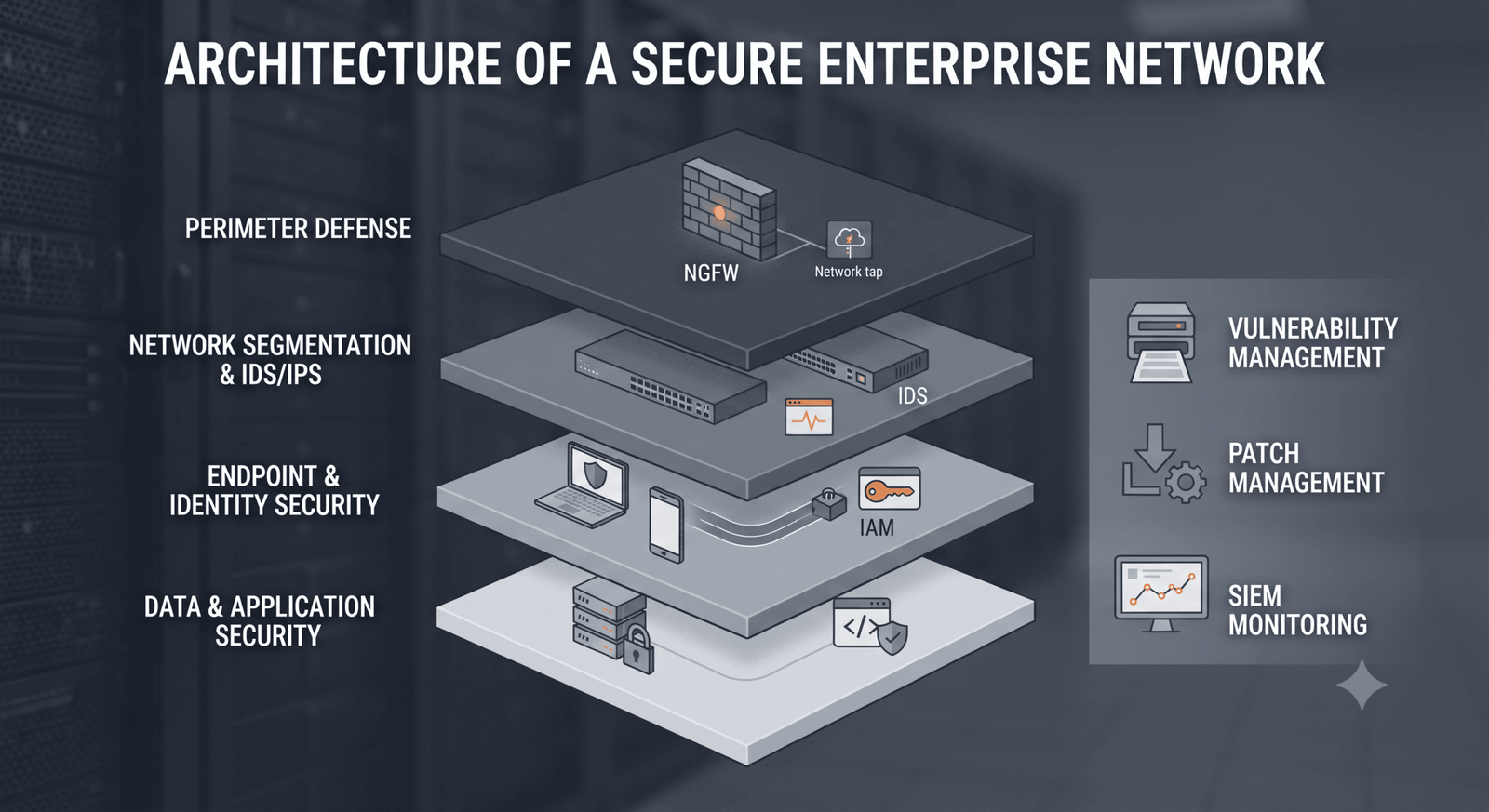
Network security protects network infrastructure and communications from unauthorized access and malicious activity. Firewalls, intrusion detection and prevention systems, network segmentation, secure configurations, and traffic monitoring are common components.
The aim is to control who and what can communicate with systems while detecting suspicious network behavior.
2. Application Security
Application security focuses on protecting websites, APIs, mobile apps, and other software from vulnerabilities.
The current OWASP Top 10:2025 lists major web application risks including broken access control, security misconfiguration, software supply chain failures, cryptographic failures, injection, insecure design, authentication failures, and logging and alerting failures.
Application security should therefore begin during software development rather than after an application is deployed.
3. Cloud Security
Cloud security protects data, applications, identities, and infrastructure hosted on cloud platforms. It includes identity and access management, secure configurations, encryption, logging, vulnerability management, and protection of cloud workloads.
Cloud environments also make visibility and access management particularly important because resources may be distributed across multiple services and locations.
4. Endpoint Security
Endpoint security protects devices such as laptops, desktops, servers, and mobile devices. Endpoint protection platforms and endpoint detection and response tools can help identify malware, suspicious processes, unauthorized activity, and other security events.
5. Data Security
Data security focuses on protecting sensitive information from unauthorized access, alteration, or loss. Encryption, access controls, data classification, secure backups, and appropriate retention policies are common measures.
6. Identity and Access Management
Identity security determines who can access a resource and what they are allowed to do. Multi-factor authentication (MFA), least-privilege access, strong authentication, and regular access reviews are important controls.
This area is increasingly important in modern environments where employees, applications, devices, and cloud services all require access to digital resources.
Common Cybersecurity Threats
Cyber threats change over time, but several attack types remain common and important to understand.
Phishing and Social Engineering
Phishing attempts to trick users into revealing credentials, opening malicious files, visiting fraudulent websites, or approving unauthorized actions. Social engineering more broadly relies on manipulating people rather than exploiting only technical vulnerabilities.
Security awareness training and strong authentication can reduce the risk created by these attacks.
Malware
Malware is malicious software designed to perform harmful actions. It includes categories such as viruses, worms, trojans, spyware, and ransomware.
Ransomware
Ransomware can encrypt files or systems and make them unavailable to legitimate users. Modern ransomware incidents can also involve data theft and threats to publish stolen information. CISA recommends preparation, prevention, detection, response, and recovery measures to reduce ransomware risk.
Password and Credential Attacks
Attackers may obtain passwords through phishing, credential stuffing, password spraying, malware, or previously leaked credentials. Reusing passwords across multiple services increases the potential damage from a single compromised account.
Denial-of-Service Attacks
A denial-of-service attack attempts to overwhelm a system or service so legitimate users cannot access it. Distributed denial-of-service, or DDoS, attacks use multiple systems or sources to generate traffic or requests.
Vulnerability Exploitation
Unpatched software, insecure configurations, outdated dependencies, and application weaknesses can provide attackers with opportunities to gain unauthorized access.
That is why vulnerability management, patch management, secure configuration, and continuous monitoring are important parts of cybersecurity.
Essential Cybersecurity Tools
Cybersecurity tools vary depending on the environment and objective. No single tool provides complete protection.
Firewalls control network traffic according to defined security rules.
Antivirus and endpoint detection and response (EDR) tools help identify and respond to malicious activity on devices.
Intrusion detection and prevention systems (IDS/IPS) monitor network activity for suspicious patterns and can help block certain attacks.
SIEM platforms collect and correlate security logs from multiple sources to support monitoring, investigation, and incident response.
Vulnerability scanners help organizations identify known weaknesses across systems, applications, and infrastructure.
For cybersecurity professionals and students, tools such as Wireshark can be useful for network traffic analysis, Nmap for network discovery and security testing, and Burp Suite for web application security testing. These tools should be used only in systems and environments where the user has appropriate authorization.
Cybersecurity Best Practices
Effective cybersecurity starts with basic controls and builds from there.
First, maintain an accurate inventory of hardware, software, applications, accounts, and cloud resources. You cannot properly protect systems that you do not know exist.
Use MFA wherever practical, especially for privileged and remotely accessible accounts. Apply the principle of least privilege so users and applications receive only the access they actually need.
Keep operating systems, applications, libraries, network devices, and security tools updated. Regular patch management reduces exposure to known vulnerabilities.
Protect important information with encryption, access controls, and secure backups. Backups should also be tested periodically to confirm that recovery actually works.
Organizations should continuously monitor important systems and maintain an incident response plan. Knowing who should investigate, contain, communicate, and recover from an incident before an attack occurs can save valuable time during a real event.
For a structured approach, organizations can use the NIST CSF 2.0 or the CIS Critical Security Controls v8.1, which provides a prioritized set of safeguards for improving cybersecurity defenses.
Another increasingly important approach is Zero Trust, which avoids giving implicit trust to users or devices simply because they are inside a particular network. NIST describes zero trust as an architecture focused on protecting resources through explicit authentication and authorization rather than relying primarily on network location.
Cybersecurity for Students and Beginners
For beginners, cybersecurity can seem like a huge field, but it becomes easier when learned step by step.
Start with networking fundamentals such as TCP/IP, DNS, HTTP, ports, and common network protocols. Then learn Linux, basic programming, operating-system concepts, authentication, cryptography, and web application fundamentals.
After that, explore practical areas such as ethical hacking, network security, penetration testing, vulnerability assessment, cloud security, digital forensics, and incident response.
Hands-on labs and legal practice environments are particularly useful because cybersecurity requires more than memorizing terminology. Understanding how systems work makes it easier to understand how they can fail and how they can be defended.
Final Thoughts
Cybersecurity is no longer a niche concern reserved for security teams. It is a fundamental part of software development, cloud computing, networking, data management, and digital business.
Understanding cybersecurity threats, security types, cybersecurity tools, vulnerability management, access control, and security best practices provides a strong foundation for both technical professionals and organizations.
The most effective cybersecurity strategy is not based on one product or one defensive technique. It combines people, processes, technology, monitoring, secure design, risk management, and continuous improvement. As systems become more connected, cybersecurity will remain an essential engineering discipline rather than an optional layer added at the end.
Have any thoughts?
Share your reaction or leave a quick response — we’d love to hear what you think!
-
 0
0 - 0
- 0



