
The Smart India Hackathon (SIH) has become one of the biggest platforms for students in India who want to turn an engineering idea into a working solution for a real-world problem.
But participating in SIH is not simply about building something impressive.
The harder part is often choosing the right Smart India Hackathon problem statement.
A good problem statement gives your team enough room to demonstrate technical ability, innovation and real-world impact without becoming so complicated that you cannot build a convincing prototype within the hackathon timeline.
This guide explains how Smart India Hackathon problem statements work, what kinds of challenges students can expect, how to choose one strategically, and how to turn a problem statement into a strong project idea.
Table of Contents
What Is Smart India Hackathon?
Smart India Hackathon (SIH) is a nationwide innovation initiative associated with India’s Ministry of Education’s Innovation Cell and AICTE. It challenges student teams to develop technology-based solutions for problems submitted by government organizations, ministries, departments and industry partners.
The fundamental idea is simple:
Instead of building a project just because it looks good on a resume, students build a solution for a problem that someone actually wants solved.
That distinction matters.
A typical college project might begin with a technology such as artificial intelligence, IoT or blockchain and then look for something to do with it.
SIH works in the opposite direction.
The problem comes first. The technology is selected afterward.
Official SIH material describes problem statements as challenges submitted by ministries, state governments, private organizations and other participating bodies.
That is why the best SIH projects usually combine three things:
- A clearly defined real-world problem
- A technically feasible solution
- A measurable impact
Smart India Hackathon Problem Statements: What You Actually Get
A Smart India Hackathon problem statement is more than a project title.
It normally gives your team the context required to understand the challenge, including information about the problem, the organization presenting it and what kind of solution is expected.
Recent SIH datasets have included fields such as:
- Problem Statement ID
- Problem Statement Title
- Organization
- Department
- Category
- Theme
- Problem Description
- Expected solution
- Expected outcomes
- Dataset or reference links where applicable
This makes the selection process much more structured than simply choosing a random hackathon idea.
For example, recent SIH challenges have covered areas such as healthcare, agriculture, transportation, cybersecurity, tourism, disaster management, education, automation and clean technology.
Smart India Hackathon 2026 Problem Statements
For students searching specifically for Smart India Hackathon 2026 problem statements, the latest available problem-statement datasets show a large collection of challenges divided between software and hardware categories.
A current 2026 snapshot lists hundreds of problem statements spanning areas such as AI-based monitoring, smart logistics, healthcare, agriculture, disaster management, cybersecurity and other national-priority domains.
The exact count can change as the official catalogue is updated, so teams should always verify the latest list and statement details on the official SIH portal before finalizing a project.
That is particularly important because the problem statement is the source of truth—not a third-party summary.
The Main Categories of SIH Problem Statements
One of the easiest ways to narrow down the enormous list of Smart India Hackathon problem statements is to start with the category.
The two broad categories are:
Software Problem Statements
Software challenges are suitable for teams working on applications, platforms, AI/ML systems, data systems, automation tools, cybersecurity solutions, mobile applications, web applications and similar technologies.
Recent SIH problem statements have included solutions involving:
- Artificial intelligence
- Machine learning
- Computer vision
- Natural language processing
- Web applications
- Mobile applications
- GIS and mapping
- Data analytics
- Cloud platforms
- Blockchain
- Cybersecurity
- Automation
For software teams, the key question is not simply “Can we build this?”
It is:
“Can we demonstrate the complete solution convincingly with the time and resources we have?”
Hardware Problem Statements
Hardware challenges are aimed at teams capable of developing physical prototypes or integrated hardware-software systems.
These can involve:
- IoT
- Embedded systems
- Sensors
- Robotics
- Drones
- Communication systems
- Automation
- Industrial monitoring
- Smart devices
- Edge computing
Hardware projects can be extremely compelling during a demonstration because judges can see the solution working in the real world.
The trade-off is development time.
A sophisticated hardware concept that cannot be prototyped reliably is usually less useful than a simpler system that works.
Major Smart India Hackathon Themes
SIH problem statements are organized around themes so that students can find challenges matching their interests and technical strengths.
Recent SIH editions have covered themes including areas such as:
- Agriculture, FoodTech & Rural Development
- Blockchain & Cybersecurity
- Clean & Green Technology
- Disaster Management
- Fitness & Sports
- Heritage & Culture
- MedTech / BioTech / HealthTech
- Smart Automation
- Smart Education
- Transportation & Logistics
- Travel & Tourism
- Renewable and sustainable technologies
- Robotics and drones
- Smart vehicles
The precise theme structure can change between editions.
For example, the official SIH Junior Edition has previously listed themes ranging from disaster management and space technology to agriculture, healthcare, robotics, cybersecurity and clean technology.
So don’t choose a project solely because a particular theme sounds fashionable.
Choose a theme where your team has an actual advantage.
How to Choose the Best Smart India Hackathon Problem Statement
This is where many teams make their first mistake.
They search for the most exciting problem statement.
Instead, search for the problem statement your team can solve better than competing teams.
A useful way to evaluate a problem is to score it against five factors.
| Factor | What to Ask |
|---|---|
| Technical feasibility | Can we build a working prototype? |
| Team capability | Do we already have the required skills? |
| Innovation | Is our approach meaningfully different? |
| Demonstrability | Can we show the solution clearly? |
| Impact | Can we explain why the solution matters? |
Give each potential problem a score from 1 to 5.
After evaluating 10–15 statements, patterns usually become obvious.
The problem that sounded exciting initially may turn out to be extremely difficult.
Another statement that looked ordinary may have an excellent combination of feasibility, innovation and impact.
Don’t Choose a Problem Just Because It Uses AI
This deserves its own section because it is one of the biggest traps in student hackathons.
If a problem statement can be solved with AI, adding an AI model does not automatically make the solution innovative.
For example:
Weak approach:
“We will create an AI-based platform.”
That’s a technology description, not a solution.
Stronger approach:
“The system will analyze X data, identify Y risk, notify Z stakeholder and recommend an appropriate action.”
Now there is a complete workflow.
The strongest projects usually explain:
Input → Processing → Decision → Action → Outcome
That is much more convincing than simply listing technologies.
How to Read an SIH Problem Statement Properly
Before your team starts coding, break the statement into five parts.
1. The Actual Problem
What is going wrong today?
Don’t rewrite the entire statement.
Reduce it to one sentence.
For example:
Farmers cannot reliably access timely information needed to make decisions about crop health.
Now the team knows what it is actually trying to solve.
2. The Target User
Who experiences the problem?
It could be:
- A farmer
- A doctor
- A student
- A government officer
- A logistics operator
- A tourist
- A manufacturer
- A citizen
- A security professional
This changes the design of your solution.
A government dashboard and a farmer-facing mobile application may solve the same underlying problem, but they require completely different user experiences.
3. The Existing Gap
Ask:
What is missing from the current system?
This is where your innovation should begin.
Do not assume that the absence of a perfect solution means nothing exists.
There may already be:
- Government portals
- Mobile applications
- Databases
- Manual workflows
- Commercial products
- Research prototypes
Your job is to identify the gap.
4. The Expected Solution
Look carefully at what the problem statement actually asks for.
If the statement expects a monitoring system, don’t build only an informational website.
If it requires real-time alerts, demonstrate real-time alerts.
If it involves field data, explain how that data will actually reach your system.
The closer your prototype is to the underlying requirement, the easier it becomes for judges to understand its value.
5. The Expected Impact
Finally, ask:
What changes if our solution works?
Try to express this numerically where possible.
Instead of:
“Our system improves healthcare.”
Say:
“The system is designed to reduce manual screening time and prioritize high-risk cases for further review.”
Specific outcomes make your proposal much stronger.
How to Turn a Problem Statement Into a Winning Project Idea
Once you’ve selected your problem statement, don’t immediately start coding.
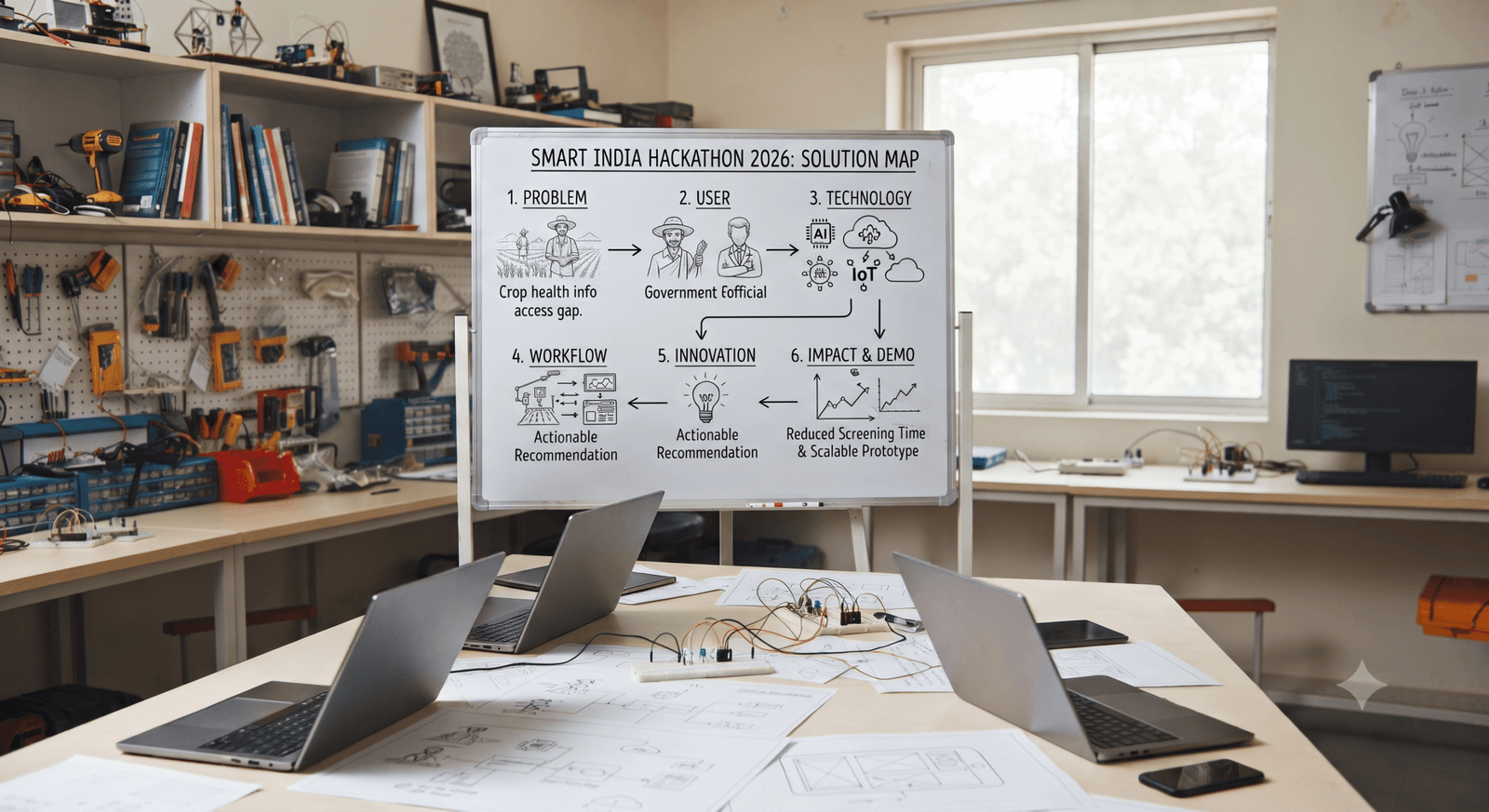
Create a one-page solution map first.
Problem
What is happening today?
User
Who faces the problem?
Solution
What are we building?
Technology
What technologies will power it?
Workflow
How does the system work from beginning to end?
Innovation
Why is this better than existing approaches?
Impact
What measurable improvement can it create?
Demo
What will the judges actually see?
That final question is surprisingly important.
A great idea that cannot be demonstrated clearly is difficult to evaluate.
Examples of Strong SIH Project Directions
The best project direction depends on the actual problem statement, but several technology patterns appear repeatedly in recent hackathons.
AI + Public Safety
A system could combine computer vision, geospatial information and real-time alerts to identify potentially dangerous situations.
The important part isn’t simply saying “AI detects danger.”
The project should demonstrate:
Detection → Verification → Alert → Response
AI + Agriculture
Agricultural challenges can combine:
- Crop imagery
- Weather information
- Soil data
- Disease detection
- Localized recommendations
- Market information
A useful project should turn data into an actionable recommendation rather than simply displaying information.
Healthcare + Predictive Analytics
Healthcare problem statements can use machine learning to identify patterns in patient or operational data.
But the product needs a human-centered workflow.
The output might be:
Patient data → Risk assessment → Priority level → Recommended next action
rather than just an AI prediction score.
IoT + Smart Infrastructure
IoT projects can combine sensors, edge devices, cloud platforms and dashboards.
For example:
Sensor → Edge processing → Cloud → Analytics → Alert → Dashboard
This type of architecture can work particularly well for monitoring, logistics, energy and industrial problems.
What Makes a Smart India Hackathon Project Stand Out?
A flashy interface isn’t enough.
A strong SIH solution usually has five characteristics.
1. It solves the exact problem
The project should clearly map back to the problem statement.
2. It is technically credible
Don’t promise a system that would require a massive engineering team to deploy.
3. It has a clear differentiator
There should be a reason your solution is better, faster, cheaper, safer or more accessible.
4. It can be demonstrated
The judges should understand the solution within minutes.
5. It can scale
Explain how the prototype could eventually work outside the hackathon.
This last point is particularly useful for government-oriented challenges.
Smart India Hackathon Evaluation: Think Beyond the Prototype
SIH guidance has historically emphasized factors such as novelty, complexity, clarity, feasibility, practicability, sustainability, scale of impact, user experience and potential for future progression when evaluating ideas.
That gives teams a useful framework.
Don’t build only for the demo.
Build a demo that tells the story of a real product.
For example:
Problem
A government department currently relies on a slow manual process.
↓
Solution
Your platform automates data collection and prioritization.
↓
Technology
AI + API + dashboard + notification system.
↓
Demo
A new case enters the system.
↓
The platform analyzes it.
↓
The system generates a recommendation.
↓
The responsible user receives an alert.
↓
The dashboard shows the result.
That’s a story.
And stories are much easier to judge than a collection of disconnected features.
Smart India Hackathon Problem Statements From Previous Years
The search data around SIH shows substantial interest in historical problem statements.
For example, your keyword dataset contains searches for:
- Smart India Hackathon 2017
- Smart India Hackathon 2018
- Smart India Hackathon 2019
- Smart India Hackathon 2020
- Smart India Hackathon 2021
- SIH 2019 problem statements
- SIH 2019 topics
- SIH 2020 problem statements
- SIH 2021 topics
- Smart India Hackathon winners
- Smart India Hackathon projects
These historical searches are useful for one reason: previous SIH problems can help teams understand the kind of challenges that have been presented before.
They should not, however, be confused with the current year’s official problem statements.
A 2019 problem statement may still be useful for research, but it is not a substitute for checking the current SIH catalogue.
Where to Find Smart India Hackathon Problem Statements
The safest place to verify a problem statement is the official Smart India Hackathon portal.
Third-party websites, GitHub repositories and student-created databases can be useful for searching and filtering large datasets, but the official SIH listing should remain the final reference before your team commits to a problem.
This matters because problem statements can be updated, replaced or presented differently across editions.
The official SIH ecosystem has also published guidelines explaining the submission and evaluation process.
How to Shortlist SIH Problem Statements as a Team
Don’t let every team member pick a completely different problem and spend two days arguing about it.
Use a shortlist.
Step 1: Collect 10–20 problem statements
Choose statements related to your team’s skills.
Step 2: Remove technically unrealistic ideas
If your team has no hardware experience, don’t choose a problem requiring a sophisticated physical prototype unless you have a realistic plan.
Step 3: Score each problem
Rate:
- Feasibility
- Innovation
- Team skill fit
- Impact
- Demo potential
Step 4: Select your top three
Now research those three much more deeply.
Step 5: Build a mini proof of concept
Spend a few hours validating the hardest technical assumption.
If the core technology doesn’t work, discover that before committing your team.
The Biggest Mistakes Teams Make
Choosing the Most Complicated Problem
Complexity isn’t the same thing as innovation.
A simpler solution that works can be more convincing than an ambitious solution that barely functions.
Building Before Understanding
Don’t start coding after reading only the title.
Read the complete statement.
Adding Technology for the Sake of Technology
AI, blockchain, IoT and AR/VR are tools.
They aren’t innovations by themselves.
Ignoring the User
A technically brilliant system can fail if the intended user cannot realistically operate it.
Overloading the Prototype
You don’t need 25 features.
You need the right five features working extremely well.
Ignoring Scalability
Explain what happens after the hackathon.
Who operates the system?
Where does the data come from?
What does deployment cost?
How does it integrate with existing infrastructure?
These questions turn a student prototype into a credible product concept.
How to Prepare Your SIH Presentation
Once the problem and solution are finalized, your presentation should tell a simple story.
A strong structure is:
Slide 1: Problem
What needs to be solved?
Slide 2: Why It Matters
Who is affected and what is the impact?
Slide 3: Your Solution
What exactly are you proposing?
Slide 4: How It Works
Show the architecture or workflow.
Slide 5: Technology
Explain the important technical components.
Slide 6: Impact and Future Scope
Show what changes if the solution is deployed.
Don’t turn the presentation into a wall of text.
A diagram that explains the complete workflow can often communicate more than several paragraphs.
Smart India Hackathon Ideas: How to Find the Right One
If you’re searching for Smart India Hackathon ideas, don’t begin with:
“What project can we make with Python?”
Begin with:
“What problem can our team solve unusually well?”
Then work backward.
For example:
Problem → User → Constraints → Solution → Technology → Prototype → Impact
That approach naturally produces stronger project ideas.
It also prevents the common situation where a team builds an impressive technology demonstration that doesn’t actually solve the assigned problem.
Why SIH Problem Statements Are Valuable for Engineering Students
There is a reason searches for Smart India Hackathon problem statements, SIH projects and previous SIH topics continue to attract students.
The competition gives engineering students an opportunity to work on problems that resemble real engineering work.
You may have to deal with:
- Ambiguous requirements
- Limited development time
- Multiple stakeholders
- Data limitations
- Hardware constraints
- User experience
- System integration
- Testing
- Scalability
- Presentation
That’s much closer to professional engineering than simply completing a textbook assignment.
Even if a team doesn’t win, the experience of taking a real problem from requirements to prototype can be extremely valuable.
Final Thoughts: Choose the Problem Before the Technology
The biggest lesson from Smart India Hackathon problem statements is also the simplest:
Don’t start with the technology. Start with the problem.
A strong SIH project doesn’t need every emerging technology.
It needs a clear problem, a realistic solution, a technically sound implementation and a convincing demonstration of impact.
If you’re currently exploring the latest Smart India Hackathon 2026 problem statements, start by building a shortlist around your team’s strongest skills. Compare feasibility, innovation, impact and demo potential before making the final decision.
And before submitting anything, verify the latest statement, eligibility requirements and competition guidelines through the official SIH portal.
The winning idea isn’t necessarily the most complicated one.
It’s the one that makes the judges think:
“This team understood the problem—and they built something that could actually solve it.”
Have any thoughts?
Share your reaction or leave a quick response — we’d love to hear what you think!
-
 0
0 - 0
- 0



