
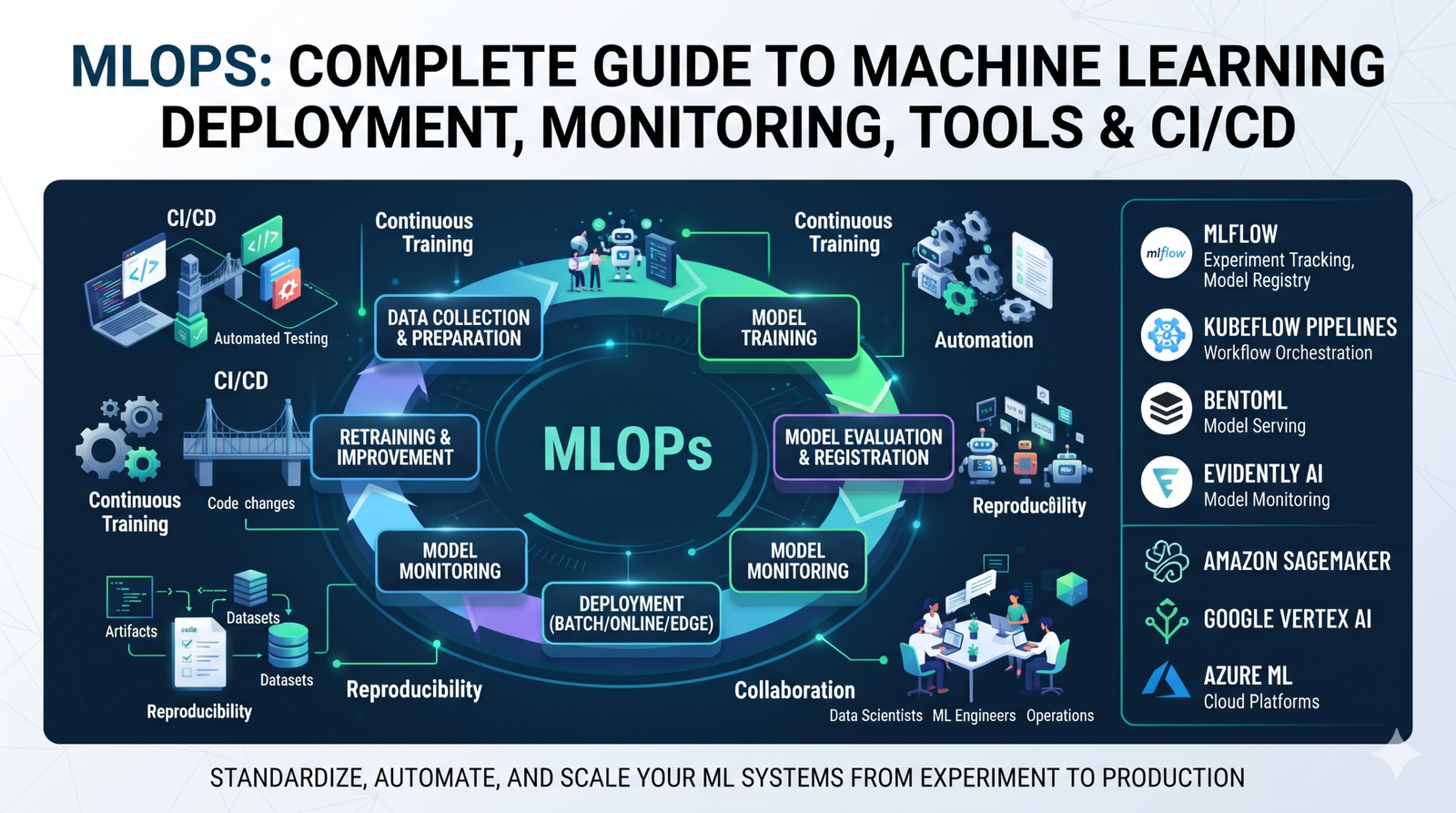
Building a machine learning model is only one part of a successful machine learning project. A model may perform well during training and testing, but deploying it into a real application introduces new challenges. Data can change, predictions can become less reliable, infrastructure can fail, and model updates may require careful testing before release.
This is where MLOps becomes important.
MLOps, or Machine Learning Operations, combines machine learning development with software engineering and operational practices to help teams build, deploy, monitor, and maintain machine learning systems reliably.
A well-designed MLOps workflow connects data preparation, model training, evaluation, deployment, monitoring, and retraining into a repeatable process. It helps data scientists and machine learning engineers move beyond isolated experiments and manage models throughout their production lifecycle.
This guide explains the MLOps lifecycle, how an MLOps pipeline works, machine learning deployment approaches, CI/CD and continuous training, model monitoring, popular MLOps tools, and a practical roadmap for beginners.
Table of Contents
What Is MLOps?
MLOps is a set of practices, processes, and tools used to manage the development, deployment, monitoring, and maintenance of machine learning models in production.
It brings together three major areas:
- Machine learning: Data preparation, model development, experimentation, and evaluation
- Software engineering: Version control, testing, automation, and application development
- Operations: Deployment, infrastructure management, monitoring, reliability, and maintenance
Traditional machine learning workflows often involve developing a model in a notebook, evaluating its performance, and manually transferring it into an application.
This approach can work for small experiments, but it becomes difficult to manage when models need frequent updates, multiple environments, reproducible experiments, or production-level reliability.
MLOps introduces a more structured process. It helps teams track which data and code produced a model, automate repeatable workflow stages, validate model releases, and monitor the model after deployment.
For example, a data scientist may develop a customer churn prediction model using historical customer data. MLOps practices help the team turn that model into a production service, monitor its predictions, and update it when customer behaviour changes.
Why Is MLOps Important?
Machine learning models behave differently from traditional software components because their output depends on data as well as code.
A software application may continue working when its code remains unchanged. A machine learning model, however, can become less useful when the real-world data it receives changes significantly.
MLOps helps address several challenges.
Reproducibility
Machine learning experiments involve datasets, parameters, code, dependencies, and training configurations.
Without proper tracking, it can be difficult to reproduce a model or understand why one experiment performed better than another.
MLOps encourages teams to record experiment details and maintain consistent environments.
Reliable Model Deployment
A trained model needs to be packaged, tested, and deployed into an environment where applications can use it.
MLOps helps standardize deployment workflows and reduce manual steps that may introduce errors.
Continuous Model Monitoring
A model’s performance can change after deployment.
Monitoring helps teams detect issues such as changes in input data, unexpected prediction patterns, increasing latency, or declining predictive performance.
Collaboration Between Teams
Data scientists, ML engineers, software developers, and operations teams often work on different parts of a machine learning system.
MLOps provides shared workflows, artifacts, and release processes that help these teams coordinate their work.
Efficient Model Maintenance
Production models may need updates because of new data, changing business requirements, or improvements in model development.
Automated pipelines can make these updates more repeatable and easier to validate.
MLOps vs. DevOps
MLOps builds on many DevOps practices, but machine learning systems introduce additional requirements.
DevOps focuses on improving software development and operations through automation, testing, deployment, and monitoring.
MLOps applies similar principles to machine learning systems, where data and model behaviour also need to be managed.
| Aspect | DevOps | MLOps |
|---|---|---|
| Main focus | Software development and operations | Machine learning development and operations |
| Main artifacts | Source code, packages, services | Code, datasets, features, models, and pipelines |
| Testing | Unit, integration, and system tests | Software tests plus data and model validation |
| Versioning | Code and application versions | Code, data references, model versions, and pipeline versions |
| Deployment | Application or service release | Model, pipeline, or prediction service release |
| Monitoring | Availability, errors, latency, resource use | Service health plus data and model behaviour |
| Updates | Code changes and releases | Code changes, data changes, retraining, and model releases |
The key difference is that MLOps must manage both the software system and the machine learning model’s relationship with data.
The MLOps Lifecycle
The MLOps lifecycle describes the stages involved in developing and operating a machine learning system.
A typical lifecycle includes:
<text weight=”medium” textAlign=”center”>Data → Preparation → Training → Evaluation → Deployment → Monitoring → Retraining</text>
These stages are connected rather than strictly linear. Monitoring may reveal a problem that requires changes to the data, features, model, or deployment configuration.
1. Data Collection and Preparation
Machine learning models depend on the quality and relevance of their training data.
This stage involves collecting data from suitable sources, checking its quality, handling missing values, preparing features, and creating appropriate training and evaluation datasets.
Data validation can check:
- Required columns and data types
- Missing or invalid values
- Unexpected changes in data schema
- Duplicate records
- Value ranges and data consistency
Data preparation should be repeatable so that the same process can be applied during training and production inference where appropriate.
2. Model Training
During model training, the team selects an algorithm, prepares the training configuration, and fits the model using the available data.
Different experiments may use different algorithms, hyperparameters, feature sets, or training data.
Experiment tracking helps record the configuration and results of each run.
3. Model Evaluation
The trained model is evaluated against a suitable validation or test dataset.
The evaluation metrics depend on the problem.
For example:
- Classification may use precision, recall, F1-score, or ROC-AUC.
- Regression may use MAE, MSE, or RMSE.
- Recommendation systems may use ranking or recommendation quality metrics.
A model should not be approved for deployment merely because it completed training. It should meet predefined quality and business requirements.
4. Model Versioning and Registration
Once a model has been evaluated, the team can store it in a model registry or another controlled artifact system.
A model registry helps organize model versions and associate them with information such as experiment runs, evaluation metrics, and deployment status.
MLflow Model Registry provides model lifecycle management features including versioning and lineage.
5. Model Deployment
The approved model is packaged and made available for prediction.
Depending on the application, deployment may involve a batch prediction workflow, an online prediction API, or a model running on an edge device.
6. Model Monitoring
After deployment, teams monitor both the service and the model.
Service monitoring may include latency, error rates, availability, and resource usage.
Model monitoring may include input data changes, prediction distributions, and predictive performance when actual outcomes become available.
7. Retraining and Improvement
When monitoring or business requirements indicate that an update is needed, the team can initiate a new training cycle.
Retraining may happen on a schedule, when new data becomes available, or when a validated monitoring condition is met.
Retraining should not automatically mean deploying the new model. The candidate model still needs evaluation and release approval.
What Is an MLOps Pipeline?
An MLOps pipeline is an automated or partially automated workflow that connects the stages of machine learning development and production.
A pipeline may contain tasks for data validation, feature preparation, model training, evaluation, model registration, deployment, and monitoring.
Each task produces outputs that can be used by later stages.
For example, a model training step may produce a trained model and evaluation metrics. The next step can check whether the model meets the required performance threshold before allowing it to proceed to registration or deployment.
MLOps pipelines help teams:
- Standardize repeated workflows
- Track pipeline runs and artifacts
- Reduce manual execution
- Reuse workflow components
- Validate data and model quality
- Make failures easier to identify
- Support reproducible model development
Tools such as Kubeflow Pipelines allow teams to define machine learning workflows as connected components and manage their execution.
How to Build an MLOps Pipeline: A Practical Example
Consider a machine learning project that predicts whether a customer may stop using a subscription service.
The objective is to develop a customer churn prediction model and make its predictions available to a business application.
Step 1: Collect and Validate Customer Data
The pipeline collects customer information such as subscription history, usage patterns, support interactions, and relevant account attributes.
Before training begins, the data validation step checks whether the expected fields exist and whether the data meets quality requirements.
If required data is missing or the schema has changed unexpectedly, the pipeline should stop or route the issue for investigation.
Step 2: Prepare Features
The pipeline transforms raw data into features that the model can use.
For example, it may calculate:
- Number of support requests during a defined period
- Recent changes in product usage
- Subscription duration
- Payment history indicators
The feature preparation process should be consistent between training and inference to reduce the risk of training-serving skew.
Step 3: Train the Model
The training step uses the prepared dataset to train a classification model.
The pipeline records the algorithm, parameters, dataset reference, code version, and relevant metrics.
Experiment tracking tools such as MLflow Tracking can help organize these details.
Step 4: Evaluate the Model
The candidate model is evaluated against a holdout dataset.
Suppose the project requires the model to meet a defined recall threshold while keeping false positives within an acceptable range.
The pipeline compares the model’s results with the release criteria.
If the model does not meet the criteria, it should not proceed to production automatically.
Step 5: Register the Model
The validated model is stored in a model registry with its version and supporting metadata.
The team can identify which training run produced the model and review its evaluation results before release.
Step 6: Deploy the Model
The approved model is deployed as a prediction service or batch inference workflow.
The business application can then use the model to generate churn risk predictions for eligible customers.
Step 7: Monitor and Improve
The team monitors service health, input data patterns, prediction behaviour, and predictive performance when outcome labels become available.
If the model’s performance declines or the data changes significantly, the team investigates whether retraining or another model update is necessary.
The pipeline can then repeat the process with updated data and validated changes.
Machine Learning Model Deployment
Machine learning model deployment is the process of making a trained model available for use by an application, system, or business workflow.
The deployment approach depends on how and when predictions are required.
Batch Inference
Batch inference generates predictions for a collection of records at scheduled intervals or when a batch job runs.
For example, a business may generate churn risk predictions for its customer database every night.
Batch inference is useful when predictions do not need to be returned immediately for each individual request.
Online Inference
Online inference provides predictions in response to application requests.
A model may be exposed through an API so that an application can send input data and receive a prediction.
For example, an ecommerce application may request a recommendation when a customer visits a product page.
Online inference requires attention to latency, availability, request validation, and scaling.
Edge or Embedded Deployment
Some models are deployed directly to devices such as mobile applications, industrial equipment, or embedded systems.
This approach may be useful when predictions need to be generated locally or when network connectivity is limited.
Deployment Strategies
Teams may use different release strategies depending on the risk and architecture of the application.
Canary deployment: A new model is initially exposed to a limited portion of traffic before broader release.
Shadow deployment: The new model receives production inputs and generates predictions for evaluation, while the existing model continues to provide the active results.
Blue-green deployment: Two deployment environments are maintained so that traffic can be switched between the existing and new versions.
These strategies help teams evaluate releases and manage the risk of introducing a new model.
CI/CD and Continuous Training in MLOps
CI/CD is an important part of MLOps, but machine learning systems often require an additional process called continuous training.
Continuous Integration
Continuous integration involves automatically testing changes to the code or pipeline.
For an MLOps project, CI checks may include:
- Unit tests for data processing and feature code
- Pipeline component tests
- Dependency and environment checks
- Data schema validation
- Model interface tests
- Basic training and evaluation checks
The goal is to identify problems before a pipeline change reaches a production environment.
Continuous Delivery or Deployment
Continuous delivery prepares validated changes for release.
Depending on the team’s approval process, deployment may be automatic or require a manual approval step.
Model releases should include appropriate validation checks rather than relying only on successful software builds.
Continuous Training
Continuous training automates the process of retraining a model using updated data or an updated training pipeline.
A continuous training workflow may run:
- On a schedule
- When new training data becomes available
- When a monitoring condition is triggered
- When a model development change is approved
A new model should still pass evaluation and release criteria before replacing the production model.
Google Cloud’s MLOps pipeline guidance explains how CI, CD, and continuous training can be connected to automate machine learning workflows.
Machine Learning Model Monitoring
Model monitoring is the process of observing a deployed model to understand whether the system continues to operate as expected.
Monitoring should cover both infrastructure and model behaviour.
Service Monitoring
Service monitoring helps identify operational problems such as:
- High prediction latency
- Increased request errors
- Service downtime
- Unexpected resource consumption
- Failed batch jobs
These issues may affect the application even when the model itself remains statistically accurate.
Data Drift
Data drift occurs when the distribution of input data changes compared with the data used during training or a reference period.
For example, a customer churn model may receive a different distribution of customer usage patterns after a major product change.
Data drift does not automatically mean that the model’s predictions are wrong, but it can indicate that the model needs investigation.
Concept Drift
Concept drift refers to changes in the relationship between input features and the target outcome.
For example, customer behaviour that previously indicated a high likelihood of churn may become less predictive after the business changes its pricing or service policies.
Concept drift can affect predictive performance even when the input data distribution does not change dramatically.
Model Performance Monitoring
When actual outcomes or labels become available, teams can compare predictions with the observed results.
This allows them to track performance metrics such as precision, recall, error rates, or other measures appropriate to the model.
In some applications, labels arrive only after a delay. Monitoring systems should account for this rather than assuming that immediate performance measurement is always possible.
MLOps Tools and Platforms
MLOps tools support different stages of the machine learning lifecycle. Some specialize in experiment tracking or workflow orchestration, while others provide managed infrastructure for model training and deployment.
The right toolset depends on the project’s complexity, existing infrastructure, team experience, and operational requirements.
Experiment Tracking: MLflow and Weights & Biases
Experiment tracking tools help teams record model parameters, metrics, artifacts, and training runs.
MLflow supports experiment tracking and model lifecycle workflows.
Weights & Biases provides experiment tracking and related machine learning development capabilities.
These tools are useful when teams need to compare experiments and understand how a model was produced.
Workflow Orchestration: Apache Airflow and Kubeflow Pipelines
Workflow orchestration tools coordinate tasks and manage dependencies between pipeline stages.
Apache Airflow is commonly used to schedule and orchestrate data and workflow tasks.
Kubeflow Pipelines is designed for building and executing machine learning workflows using reusable components.
The best choice depends on whether the project needs general workflow orchestration, ML-specific pipeline features, or integration with an existing platform.
Model Registry: MLflow Model Registry
A model registry helps organize model versions and maintain information about their lifecycle.
It can support model review, version tracking, lineage, and controlled promotion between environments.
A registry is especially useful when multiple models or teams need a consistent process for managing production releases.
Model Serving: BentoML and KServe
Model serving tools help package and expose models for prediction.
BentoML provides capabilities for packaging and serving machine learning models.
KServe provides model serving capabilities in Kubernetes-based environments.
These tools may be appropriate when teams need more control over model serving infrastructure than a simple managed endpoint provides.
Model Monitoring: Evidently and Arize AI
Model monitoring tools help teams examine data quality, prediction behaviour, and model performance.
Evidently provides open-source capabilities for evaluating and monitoring machine learning systems.
Arize AI provides model observability and monitoring capabilities.
Before selecting a monitoring tool, check whether it supports the model types, data sources, deployment environment, and metrics required by the project.
Cloud MLOps Platforms
Cloud providers offer managed machine learning services that can support parts of the MLOps lifecycle.
Examples include:
- Amazon SageMaker
- Google Vertex AI
- Microsoft Azure Machine Learning
These platforms can provide managed infrastructure and integrated capabilities for training, pipelines, deployment, and monitoring.
Managed services may reduce infrastructure management, but teams should still evaluate cost, portability, access controls, and integration requirements.
MLOps Best Practices
A reliable MLOps workflow requires more than selecting the right tools.
Version Code, Data, and Models
Track the code used to train a model, the data reference or dataset version, the model artifact, and the pipeline configuration.
This makes it easier to reproduce experiments and investigate production issues.
Automate Repeatable Tasks
Automate data validation, training, evaluation, and deployment steps where appropriate.
Automation reduces repetitive manual work and makes the workflow more consistent.
Use Clear Model Release Criteria
Define what a model must achieve before deployment.
Release criteria may include predictive performance, data validation results, operational requirements, fairness checks where relevant, and business constraints.
Separate Development and Production Environments
Use appropriate environment separation to prevent experimental changes from affecting production systems unexpectedly.
Test pipeline and model changes in controlled environments before release.
Monitor Data and Model Behaviour
Track relevant input data, prediction patterns, service health, and actual performance when labels are available.
Monitoring should lead to an investigation or action—not simply generate dashboards that nobody reviews.
Plan for Rollback
Keep a reliable way to return to a previous model or deployment configuration if a new release causes problems.
Rollback procedures should be tested and documented.
Manage Security and Access
Protect training data, model artifacts, credentials, and production endpoints.
Use appropriate access controls and follow the security and privacy requirements that apply to the project.
Common MLOps Challenges
MLOps can improve machine learning operations, but it also introduces implementation challenges.
Poor Data Quality
Invalid or inconsistent data can affect training and prediction quality.
Data validation and clear data ownership help reduce this risk.
Training-Serving Skew
Training-serving skew occurs when the features or transformations used during training differ from those used in production inference.
Reusable feature logic and consistent preprocessing can help prevent this problem.
Model Drift
Models may become less effective as real-world conditions change.
Monitoring and a well-defined model update process help teams respond.
Complex Infrastructure
Large MLOps platforms may require knowledge of containers, cloud infrastructure, orchestration, storage, and monitoring.
Beginners should start with a manageable workflow and add complexity only when needed.
Cost Management
Training and serving machine learning models can require significant compute resources, particularly for large datasets or deep learning workloads.
Teams should monitor resource usage, choose suitable infrastructure, and avoid running unnecessary pipeline stages.
MLOps Learning Roadmap for Beginners
If you want to learn MLOps, start with the foundations and gradually build a production-style machine learning project.
Step 1: Learn Python and Machine Learning Fundamentals
Understand Python, data processing, model training, and evaluation.
Learn how to work with libraries such as pandas and scikit-learn.
Step 2: Learn Git and Software Testing
Use Git to track code changes.
Learn basic unit testing and how to organize a machine learning project into reusable modules rather than keeping everything in one notebook.
Step 3: Learn Data and Model Versioning
Understand how datasets, model artifacts, parameters, and experiment results are tracked.
Try an experiment tracking tool and a model registry.
Step 4: Build a Simple ML Pipeline
Create a pipeline that validates data, trains a model, evaluates it, and saves the resulting artifact.
Start with a local workflow before moving to more complex infrastructure.
Step 5: Learn Model Deployment
Package a trained model and expose it through a simple API or batch prediction workflow.
Understand how applications send input data and receive predictions.
Step 6: Learn CI/CD Basics
Use a version control platform and automated tests to validate changes to your ML code and pipeline.
Learn how to build and deploy a reproducible application environment.
Step 7: Add Monitoring
Track service performance and model behaviour.
Learn the difference between data drift, concept drift, and actual model performance degradation.
Step 8: Explore Orchestration and Cloud Platforms
Once the basic workflow works, explore tools such as Kubeflow Pipelines, Apache Airflow, or a managed cloud ML platform.
You do not need to learn every MLOps tool at once. Focus on understanding the purpose of each component.
MLOps Project Idea for Beginners
A useful beginner project is a customer churn prediction system with an automated ML pipeline.
The project can include:
- A public or appropriately licensed customer churn dataset
- Data validation and preprocessing
- Model training using scikit-learn
- Experiment tracking with MLflow
- Model evaluation against a baseline
- Model registration
- A prediction API
- Basic monitoring of input data and service performance
- A documented process for retraining and replacing the model
This project demonstrates the core MLOps workflow without requiring a large distributed infrastructure.
It also gives learners a practical example they can extend with cloud deployment, containerization, workflow orchestration, and automated testing.
Conclusion
MLOps helps teams manage machine learning models beyond the training stage. It connects data preparation, experimentation, model evaluation, deployment, monitoring, and retraining into a repeatable operational workflow.
A practical MLOps pipeline makes it easier to track model versions, validate releases, automate repeated tasks, and identify problems after deployment.
For beginners, the best way to learn MLOps is to build a small machine learning project and gradually introduce the practices used in production: versioning, testing, deployment, monitoring, and controlled model updates.
The goal of MLOps is not to use the largest number of tools. It is to build a machine learning system that can be reproduced, deployed, monitored, and maintained reliably as data and business requirements change.
Have any thoughts?
Share your reaction or leave a quick response — we’d love to hear what you think!
-
 0
- 0
- 0



