
Picture the viva panel on submission day. The examiner has already sat through four library management systems, two food-delivery clones, and a calculator with a login page. By the time your turn comes, the bar is not brilliance. It is staying awake. That is the quiet problem with final-year projects: the safe, familiar topics are exactly the ones that make an examiner’s eyes glaze over, and the same ones a recruiter scrolls straight past.
Here is what changed. Recruiters in 2026 barely glance at your CGPA. They open your GitHub, your Kaggle profile, and the one project you actually built and shipped. A final-year project is no longer a formality you submit and forget, it is often the single strongest thing on a fresher’s resume, or the reason a shortlist skips right over it. As many students discussing the CGPA vs skills debate on platforms like Quora have pointed out, companies are increasingly looking beyond academic scores and paying closer attention to practical abilities, portfolios, and evidence that you can actually build and solve problems.
So you are caught between two failure modes. Pick something too generic and you impress nobody. Pick something too ambitious and you never finish it, which is worse, because an unfinished project impresses no one at all. This guide fixes both. You get a simple filter for judging any idea, a process for actually shipping it, and 40 current, vetted topics across the domains where the jobs actually are. Let us get you off the beaten path and onto something worth defending.
Table of Contents
Why the wrong topic sinks you twice
A final-year project has two audiences, and they judge it differently. Your examiner wants to see rigor: a real problem, a defensible method, honest evaluation, and a working demo. Your future recruiter wants to see relevance: a modern stack, measurable impact, and proof you can ship. A weak topic fails both at once. It looks tired to the examiner and irrelevant to the recruiter, and no amount of polish on the report saves it.
The most common way projects die is not a bad idea. It is scope creep. Feature creep is the single biggest reason final-year projects fail to ship on time. You start with a clean plan, then keep bolting on features, and by month five you have forty percent of three projects instead of a finished one. The fix is boring and it works: freeze the scope early, build a working version fast, and spend the back half on evaluation and the demo.
The reframe: you are not picking a topic to survive the viva. You are picking the first serious thing a hiring manager will judge you on. Choose accordingly.
What examiners and recruiters actually want in 2026
Before you fall in love with an idea, look at where the demand is. The domains that carry the most weight on a resume are not a matter of taste. They track the roles companies are hiring for right now.

The pull is strongest around a few areas. AI and machine learning sit at the top of the priority list, and the pay gap is real: professionals with AI expertise earn around 56 percent more on average, and skills in AI-exposed roles are evolving about 66 percent faster than elsewhere. Cybersecurity is close behind, with the US Bureau of Labor Statistics projecting 32 percent growth for information security analysts, well above average. The World Economic Forum expects tens of millions of new roles built on advanced digital skills. In short, a project in these lanes does double duty: it interests the examiner and it maps to a job.
Translate that into what each audience scores you on:
- Examiners reward a clearly framed problem, a documented method, baseline comparisons, real evaluation metrics, honest limitations, and a demo that runs.
- Recruiters reward an in-demand stack, a clean GitHub repo with setup instructions, and one measurable outcome you can say out loud in an interview.
The Five-Signal Project Filter
Every idea in this guide was run through the same filter. Score any candidate topic from 0 to 10 on five signals, and the weak ones expose themselves before you commit a semester to them.
- Recruiter demand. Does the stack map to roles companies are hiring for, or to a technology that peaked three years ago?
- Examiner novelty. Has your panel seen this exact project ten times, or does it make them lean in?
- Skill transfer. Will building it teach you something you can put on a resume and defend in an interview?
- Buildability. Can you realistically finish it with the data, compute, and budget you actually have?
- Demo impact. Does it show well live, in the ninety seconds you get in front of the panel?
Plot a few domains on those five axes and the trade-offs get obvious. Generative AI scores high almost everywhere, which is why it dominates this year. Blockchain still demos beautifully and reads as novel, but recruiter demand has cooled from its peak. IoT wins on demo impact because a physical device in the room is memorable, but buildability drops because hardware costs money and breaks.

How to use it: the goal is not a perfect score on all five. It is a shape that fits you. If you cannot get GPU time, a lower-buildability deep learning project is the wrong call no matter how much recruiters love the domain.
How to pick one you can actually finish
A topic is only as good as your ability to ship it. This six-step path is what separates a project that ends in a confident demo from one that ends in an apology to the panel.

Start with interest, not hype. A hard project aligned with something you genuinely enjoy beats an easy one picked only for convenience, because you will spend months with it. If Python is your strongest language or you want to start with something manageable before increasing the scope, exploring a few Python projects for beginners can help you identify practical ideas that can later grow into a stronger final-year project.
Audit feasibility next. Does the dataset exist on Kaggle, a government portal, or a public API? Can your laptop train the model, or do you need Colab or Kaggle GPUs? Does the IoT or blockchain hardware fit your budget? A brilliant idea you cannot finish is worth less than a modest one you can demo end to end.
Read three or four recent papers. Skim IEEE or arXiv work on your topic so your literature review writes itself and you know what has already been tried.
Validate with your guide before you commit. Bring two or three shortlisted ideas, a proposed stack, a rough timeline, and the metrics you will evaluate on. A short proposal beats a long one.
Freeze the scope once approved. Write down the features you will build and, just as important, the ones you will not. This one habit prevents most project failures.
Ship an MVP by month three. Get a working version early, then spend the rest of the time on evaluation, the report, and a demo polished enough to survive questions. Once the implementation is stable, start documenting the work properly as well. Following a clear final-year project report format for engineering students can make it easier to organize your methodology, implementation, evaluation, results, and conclusions before submission week arrives.
The 40 project ideas, sorted by domain
Every topic below is current for 2026, maps to a hiring domain, and can be scoped to finish in a final-year timeline. Levels are a guide: Intermediate means a motivated student can build it solo, Advanced usually rewards a small team or a strong individual. Skip the recycled CRUD app and pick something with a pulse.
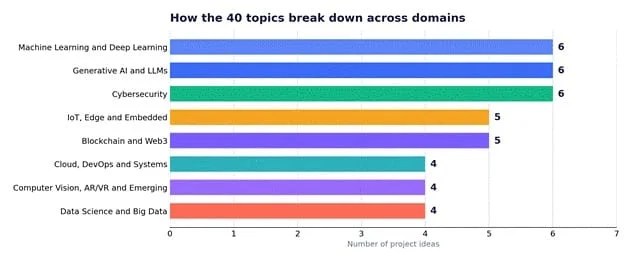
1. Generative AI and LLMs
The fastest-growing area of AI hiring. Build something domain-specific and grounded, not another bare chatbot.
| # | Project | What it does | Core stack | Level |
| 1 | RAG documentation assistant | Answers questions from a codebase or docs, grounded in retrieval instead of guesswork. | LangChain, vector DB, LLM API | Advanced |
| 2 | Multi-agent report writer | Agents that plan, search, and draft a sourced research report. | CrewAI or AutoGen, Python | Advanced |
| 3 | Grounded medical or legal Q&A | Domain answers with citations and hallucination guardrails. | RAG, embeddings, Streamlit | Advanced |
| 4 | LLM benchmarking dashboard | Compares models on accuracy, latency, tokens, and cost. | Python, multiple LLM APIs | Intermediate |
| 5 | AI mock-interview coach | Scores answers and communication, generates role-based questions. | Speech to text, LLM, React | Intermediate |
| 6 | Lecture to study-kit generator | Turns transcripts into notes, flashcards, and quizzes with source links. | Whisper, LLM, FastAPI | Intermediate |
2. Machine Learning and Deep Learning
The classic strength of a CSE project. Add real evaluation and an explainability layer to stand out.
| # | Project | What it does | Core stack | Level |
| 7 | Explainable credit-risk model | Predicts default with SHAP explanations and a fairness audit. | scikit-learn, SHAP, pandas | Advanced |
| 8 | Crop disease detector | Classifies leaf images and suggests treatment. | CNN, TensorFlow, Flask | Intermediate |
| 9 | Sign language to text and speech | Real-time gesture recognition and translation. | MediaPipe, LSTM, OpenCV | Advanced |
| 10 | Traffic or energy demand forecaster | Time-series prediction, LSTM against classical baselines. | LSTM, statsmodels, pandas | Intermediate |
| 11 | Product sentiment dashboard | Aspect-based sentiment on reviews with a live dashboard. | Transformers, spaCy, Dash | Intermediate |
| 12 | Speech emotion recognition | Detects caller emotion for call-center quality scoring. | librosa, CNN, PyTorch | Advanced |
3. Cybersecurity
High and rising demand. Pair a working tool with a clear threat model and honest evaluation.
| # | Project | What it does | Core stack | Level |
| 13 | AI network intrusion detection | Flags anomalous traffic on network flow data. | scikit-learn, CICIDS dataset | Advanced |
| 14 | Phishing URL and email detector | Explains why a link or message looks malicious. | ML, feature engineering, Flask | Intermediate |
| 15 | Log analyzer and threat dashboard | A lightweight SIEM with alerting. | ELK or Python, Grafana | Intermediate |
| 16 | Zero-trust file sharing | End-to-end encryption with access policies. | AES and RSA, JWT, Node | Advanced |
| 17 | Malware family classifier | Detects malware family from opcode or byte sequences. | ML, disassembly, Python | Advanced |
| 18 | Web scanner with AI fixes | Finds web vulnerabilities and suggests remediation. | Python, ZAP API, LLM | Advanced |
4. Blockchain and Web3
Novel and demo-friendly. Anchor it to a real trust problem so it reads as more than a buzzword.
| # | Project | What it does | Core stack | Level |
| 19 | E-voting with verifiable receipts | Tamper-evident voting through smart contracts. | Solidity, Ethereum, Web3.js | Advanced |
| 20 | On-chain certificate verification | Anti-forgery checks for academic credentials. | Solidity, IPFS, React | Intermediate |
| 21 | Supply-chain provenance tracker | Traces goods with smart-contract checkpoints. | Solidity, Hyperledger, Node | Advanced |
| 22 | Decentralized identity wallet | Self-sovereign ID and lightweight KYC. | DID, Ethereum, wallet SDK | Advanced |
| 23 | Crowdfunding or escrow dApp | Trustless funding with milestone-based release. | Solidity, Hardhat, React | Intermediate |
5. IoT, Edge and Embedded
A physical device in the room is memorable. Watch the hardware budget and keep the sensing simple.
| # | Project | What it does | Core stack | Level |
| 24 | Smart agriculture advisor | Soil and weather sensing with automated irrigation and ML advice. | ESP32, sensors, MQTT | Intermediate |
| 25 | Edge-AI patient vitals monitor | On-device anomaly alerts for vital signs. | Raspberry Pi, TinyML, MQTT | Advanced |
| 26 | Smart meter with theft detection | Energy usage analytics plus anomaly flags. | ESP32, sensors, dashboard | Intermediate |
| 27 | Air-quality monitoring network | Live pollution dashboard with forecasting. | Sensors, MQTT, time-series ML | Intermediate |
| 28 | Driver drowsiness detection | Edge computer vision fatigue alerts. | OpenCV, Jetson Nano, CNN | Advanced |
6. Cloud, DevOps and Systems
Underused by students and loved by recruiters. A clean pipeline and infrastructure as code impress fast.
| # | Project | What it does | Core stack | Level |
| 29 | End-to-end CI/CD with IaC | Build pipeline plus infrastructure as code and auto-scaling. | GitHub Actions, Terraform, AWS | Advanced |
| 30 | Serverless media pipeline | Event-driven image or file processing with observability. | Lambda, S3, CloudWatch | Intermediate |
| 31 | Kubernetes app with chaos testing | Autoscaling microservices under injected failure. | Docker, Kubernetes, Chaos Mesh | Advanced |
| 32 | Multi-cloud cost and carbon board | Optimizes spend and emissions across clouds. | Python, cloud billing APIs | Advanced |
7. Data Science and Big Data
Great for anyone who likes systems and scale. Use a real stream and show the pipeline end to end.
| # | Project | What it does | Core stack | Level |
| 33 | Real-time streaming analytics | Live metrics computed on a data stream. | Kafka, Spark, Grafana | Advanced |
| 34 | Transaction fraud detection | Streaming anomaly detection with alerting. | Spark, ML, Kafka | Advanced |
| 35 | Hybrid recommendation engine | Collaborative and content filtering with A/B evaluation. | Python, implicit, Flask | Intermediate |
| 36 | City open-data predictive board | Public data with a forecasting layer and dashboard. | pandas, Plotly, scikit-learn | Intermediate |
8. Computer Vision, AR/VR and Emerging
Visually striking and interview-friendly. A live camera demo lands harder than any slide.
| # | Project | What it does | Core stack | Level |
| 37 | AR measurement and placement | Measure rooms and place virtual objects in view. | ARCore or ARKit, Unity | Intermediate |
| 38 | Attendance with anti-spoofing | Automated, liveness-checked face attendance. | OpenCV, FaceNet, Flask | Intermediate |
| 39 | Assistive vision app | Narrates scenes and reads text for low-vision users. | YOLO, OCR, text to speech | Advanced |
| 40 | Pose estimation for exercise form | Real-time physiotherapy or workout correction. | MediaPipe, pose models | Advanced |
Mistakes that sink final-year projects
Most low grades and ignored resumes trace back to the same handful of errors. Each one has a cheap fix.
- Choosing an overdone topic. Another library or attendance CRUD app reads as tired. Fix: run it through the five signals and reject anything that scores low on novelty and demand.
- Letting scope creep. Endless new features mean nothing ships. Fix: freeze scope after approval and protect the MVP deadline.
- No data or compute plan. You realize in month four the dataset does not exist. Fix: confirm data, compute, and budget in the feasibility step, before you commit.
- Building in isolation. Surprising your guide at the end rarely goes well. Fix: validate early and check in on a schedule.
- Skipping evaluation. A demo with no metrics looks like a toy to an examiner. Fix: define baselines and evaluation metrics up front and report them honestly.
- No repo, no demo. If a recruiter cannot see it, it did not happen. Fix: keep a clean GitHub repo with setup steps, results, and limitations.
- Picking by hype, not interest. Months on a topic you dislike show in the result. Fix: choose something you actually want to spend a semester on.
The verdict
Your final-year project is the rare assignment that outlives the semester. It is the first serious thing a recruiter judges, and the difference between a viva you endure and one you enjoy. So do not settle for the topic that is easy to start. Pick the one that scores well on all five signals and that you can actually ship.
Run your shortlist through the Five-Signal Project Filter, pressure-test feasibility before you commit, freeze the scope, and get to a working demo early. Do that with any topic on this list, and you walk into the viva with something an examiner remembers and a recruiter wants to talk about.
Have any thoughts?
Share your reaction or leave a quick response — we’d love to hear what you think!
-
 0
0 - 0
- 0



