
Table of Contents
The Basics: Core Terminology for Machine Learning Evaluation
When you compare supervised and unsupervised learning, the differences come down to one fundamental question: does your data already know the answer? Understanding a handful of precise terms is what separates teams that deploy effective models from those that burn budget on the wrong approach. According to DataIntelo, the supervised learning market alone is projected to reach $12.5 billion by 2032 — a figure that underscores how much commercial weight these technical decisions carry.
Before diving into a direct comparison, ground yourself in the vocabulary that defines both paradigms:
Labeled Data
Datasets where the target output is already known and tagged. As IBM notes, supervised learning requires a ‘teacher’ in the form of labeled data to guide the algorithm toward a known outcome.
Unlabeled Data
Raw information without pre-defined categories, requiring the model to discover its own structure independently.
Ground Truth
The verified reality a model attempts to predict — essential for validating supervised and unsupervised learning outputs, though only directly measurable in the supervised context.
Feature Extraction
The process of identifying and selecting the variables that contribute most meaningfully to a model’s predictive accuracy.
Clustering
The primary unsupervised method for grouping data points by similarity, without any prior category labels guiding the process.
Mastering these five terms pays direct dividends. Organisations that misidentify their data type — treating unlabeled data as if ground truth exists — routinely waste resources on validation cycles that yield no usable signal. Getting the terminology right is, in practice, the first ROI decision in any machine learning project.
Remember: the label status of your data is the single most important factor when choosing between these two approaches.
With this foundation in place, the next step is to lay both paradigms side by side — examining how their goals, data requirements, and algorithms truly diverge.
Supervised vs Unsupervised Learning: Comparison Table
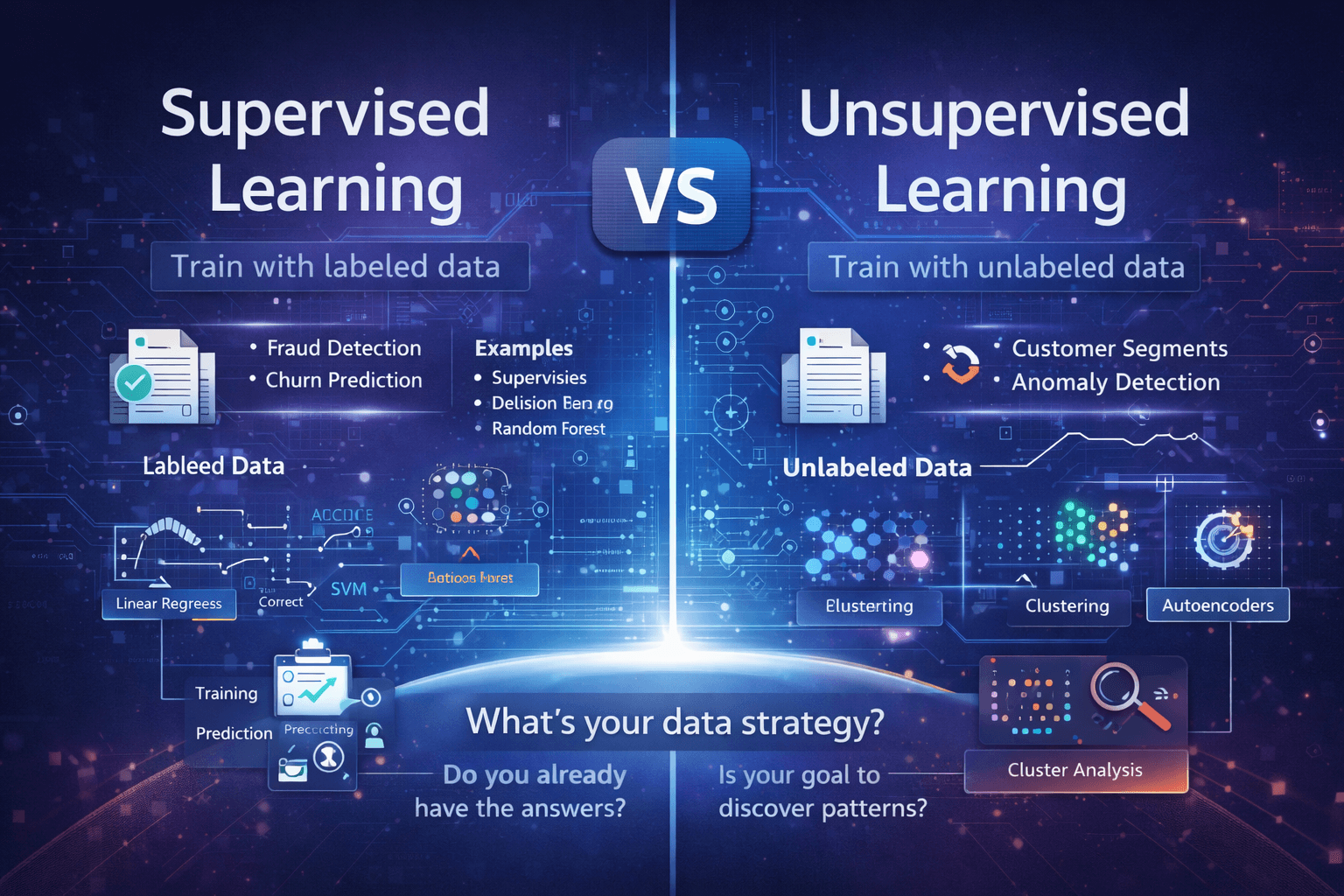
Understanding the core difference between supervised and unsupervised learning becomes far clearer with a direct side-by-side view. As covered in the previous section, the presence or absence of labelled data shapes everything — from the algorithms you select to how you measure success.
| Dimension | Supervised Learning | Unsupervised Learning |
| Goal | Predictive accuracy against a known target | Pattern discovery in unlabelled data |
| Data Input | High-cost labelled datasets | Low-cost raw, unstructured data |
| Common Algorithms | Linear Regression, SVM, Random Forest | K-Means clustering, PCA, Autoencoders |
| Complexity | Easier to validate with clear metrics (accuracy, F1) | Harder to interpret; outputs require expert review |
| Human Intervention | High — labelling is labour-intensive | Lower — but domain knowledge needed to make sense of results |
In data mining supervised vs unsupervised contexts, neither approach is universally superior. As Eric Hill, Editor in Chief at CIO Techworld, notes: “Supervised learning is preferable for recurring, well-defined problems… if you are dealing with big data and want to identify patterns within it, unsupervised learning is unparalleled.”
Can they work together? Absolutely — and increasingly, organisations should consider it. The Dual-Track approach pairs unsupervised clustering (to segment your data into meaningful groups) with a supervised model trained on each segment. This hybrid architecture addresses a genuine limitation of each method in isolation: unsupervised models lack predictive power; supervised models require labels you may not yet have. According to the Accenture AI ROI Index 2025, hybrid machine learning systems that combine both models report an average ROI improvement of 38%.
Once you understand how the two approaches contrast technically, the more pressing question becomes which one — or which combination — actually fits your specific use case.
The Bottom Line: Choosing the Right Model for Your Use Case
The debate around supervised learning vs unsupervised learning ultimately comes down to what your data looks like today — and what business question you need answered. Neither approach is universally superior; the right choice depends on your data readiness, your goal clarity, and your tolerance for labelling overhead.
Key Takeaways:
- Choose supervised learning when you have labelled historical data and a clear target outcome — fraud detection, churn prediction, and credit scoring are classic fits.
- Choose unsupervised learning when you need to discover customer segments or flag anomalies without a predefined definition of “normal” or “bad.”
- Consider a dual-track approach: use unsupervised models to segment your data first, then train supervised models on each segment to sharpen predictions.
- Validate appropriately: supervised models rely on test/train splits for measurable accuracy; unsupervised outputs require domain expert review to confirm real-world relevance.
- Future-proof your pipeline by exploring semi-supervised models, which reduce costly labelling effort whilst retaining predictive rigour.
According to the Gartner 2025 AI Adoption Report, 62% of top-performing enterprises now deploy both supervised and unsupervised models in production simultaneously — a clear signal that the most resilient data strategies are not either/or.
In practice, the architecture you choose today shapes the quality of every prediction, segment, and decision your organisation makes tomorrow. Start with the question your business is actually asking, match it to the approach that fits your data reality, and build from there.
The most effective model isn’t the most complex one — it’s the one that answers your specific business question with the data you actually have.
Have any thoughts?
Share your reaction or leave a quick response — we’d love to hear what you think!
-
 0
0 - 0
- 0



