
Let us be honest about where things stand. You are studying engineering at a moment when the ground is shifting under every technical career. The good news is that the shift is opening doors, not closing them. The World Economic Forum projects that AI and related technology will create around 170 million new roles worldwide by 2030 while displacing about 92 million, a net gain of roughly 78 million jobs. The catch is simple: the people who lose old roles are not automatically the ones who fill the new ones. The difference is skills.
This guide is not a hype piece. It is a practical map of which AI skills actually pay off, why each one matters, what it earns, and how you can start building it while you are still in college. Whether you are in your second year of B.Tech or finishing a PhD, the same principle holds: employers now hire for demonstrated skill far more than for the degree on your certificate.
Table of Contents
Why This Matters to You Right Now
Three numbers explain the urgency better than any lecture.
- Demand is exploding. US job postings for AI engineers rose 143% year over year, and LinkedIn ranked “AI Engineer” as the fastest-growing job title. Globally, AI job postings grew about 74% in a single year.
- The premium is real. PwC’s AI Jobs Barometer found that workers with AI skills command wage premiums as high as 56% over peers in the same field.
- Skills beat pedigree. Only about 23% of AI job postings now require an advanced degree, and roughly 73% of Indian employers say they hire freshers on demonstrated skills rather than the college name. A strong project portfolio can outweigh a brand-name transcript.
Read that last point again, because it changes your strategy. You do not have to wait for a placement season or a masters degree to become hireable. You need proof that you can build things that work.
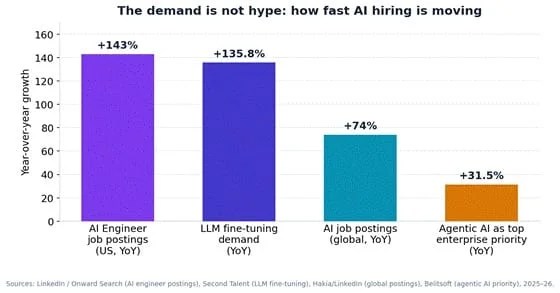
Figure 1. AI hiring is moving fast across every measure. Growth figures are year-over-year, drawn from 2025 to 2026 labour-market reports by LinkedIn, Onward Search, Second Talent, Hakia and Belitsoft.
How to Think About AI Skills: The Stack
Do not try to learn everything at once. AI skills sit in three layers, and each layer rests on the one below it. Skipping ahead is the most common mistake students make. You cannot fine-tune a large language model well if you are shaky on Python and basic machine learning. Build from the bottom up.
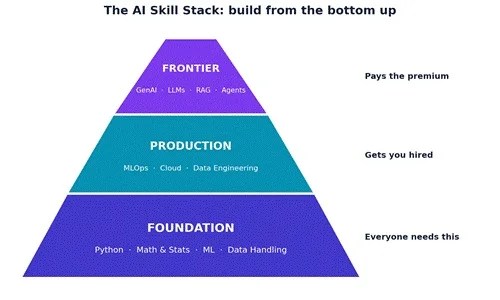
Figure 2. The AI skill stack. Foundation skills make you employable at all; production skills get you hired onto real teams; frontier skills earn the salary premium. Master each layer before climbing.
Layer 1: Foundation Skills (Non-Negotiable)
These are the skills every AI role assumes you already have. Nobody will pay a premium for them, but you cannot get in the door without them.
Python and core programming
Python is the working language of AI. Get comfortable with clean code, libraries like NumPy and pandas, and the habit of reading documentation. If you know Python well and can write readable, tested code, you are already ahead of most graduates who only know it for exams.
Machine learning and deep learning
This is the single most requested technical skill in the market, and it stays that way year after year. Understand the core algorithms, how models learn, and how to evaluate them honestly. For deep learning, learn PyTorch first. Job listings mentioning PyTorch now clearly outnumber those mentioning TensorFlow, so put your energy there.
Math, statistics and data handling
You do not need to be a mathematician, but you do need to be fluent in the linear algebra, probability and statistics that sit underneath every model. Just as important is the unglamorous skill of cleaning, joining and understanding messy real-world data. Models fail far more often because of bad data than bad algorithms.
| For PhD and M.Tech students: your research training already gives you an edge here. The ability to read a paper, reproduce a result, and reason about why a method works is exactly what research-heavy AI roles want. Do not undersell it. |
Layer 2: Production Skills (What Gets You Hired)
Here is the shift that catches most students by surprise. The market has moved from research to production. Companies have plenty of models sitting in notebooks; what they lack is people who can put those models into a live product and keep them running. This is where a lot of the jobs actually are.
MLOps and deployment
MLOps is the discipline of deploying, monitoring and maintaining models in the real world. It solves the problem that actually costs companies money: AI that breaks, drifts or quietly stops working after launch. Because so few people do it well, it commands a strong premium. Senior MLOps engineers in India earn in the range of ₹40 to ₹60 LPA, and 94% of engineering leaders report a skills gap in this and related production work.
Cloud platforms
Almost all serious AI runs on the cloud. Pick one of AWS, Azure or Google Cloud and learn to deploy and scale models on it. One recognized cloud certification is one of the highest-return things a student can add to a resume, because it proves a practical skill employers can use on day one.
Data engineering
Someone has to build the pipelines that feed clean, reliable data to models. Data engineering is less flashy than model building but deeply valued, and it pairs naturally with everything else in this layer.
Layer 3: Frontier Skills (Where the Premium Lives)
These are the newest and most valuable skills, and they exist because the field is moving faster than the supply of people who understand it. Specialists here command 25% to 45% more than generalist AI engineers at the same experience level. Over 75% of AI job listings now ask for a specific specialization rather than a generalist.
Generative AI and LLM engineering
This is the hottest area in the market. As companies move past generic chatbot integrations toward custom models trained on their own data, engineers who can adapt and fine-tune large language models are scarce and highly paid. Entry-level GenAI roles start meaningfully higher than generalist fresher roles, and senior specialists cross the top of the salary chart.
RAG and AI product engineering
Retrieval-augmented generation, or RAG, is how you make an LLM answer accurately using a company’s private knowledge instead of making things up. Learning to build RAG pipelines with vector databases and clean API design is one of the most directly employable frontier skills right now.
Agentic AI
Agentic AI, where autonomous agents plan and carry out multi-step tasks, is the fastest-growing area of all. Gartner expects around 40% of business applications to include task-specific agents by the end of 2026, up from under 5% a year earlier. The skills gap is severe: 94% of engineering leaders report they cannot find enough people who can design multi-agent systems. If you want to bet on where the next few years are heading, this is a strong place to invest.
NLP and computer vision
These established specializations still carry high premiums, especially in domains like healthcare imaging, autonomous systems and document intelligence. If a particular domain excites you, going deep in one of these remains a smart, durable choice.
What These Skills Actually Pay
Numbers focus the mind. The chart below shows approximate 2026 pay in India, from fresher to senior, for the main AI specializations. Notice how the frontier skills stretch furthest at the top end.

Figure 3. Approximate annual pay in India, 2026, by specialization. Ranges are indicative, synthesized from salary reports by Taggd, EICTA / IIT-Kanpur, Scaler and Quad AI. Product companies and global capability centres pay well above IT-services firms for the same experience.
The Skills People Forget (But Employers Notice)
Technical depth gets you the interview. These get you the offer and the promotion.
- AI literacy and prompt engineering. Even non-AI roles now expect you to use tools like ChatGPT, Claude and Gemini well. Clear, structured prompting produces better outputs and is a baseline expectation, not a niche job title.
- Communication. The engineers who rise fastest can explain what a model does and why it matters to someone non-technical. This single skill accelerates careers more than extra deep-learning theory.
- Problem-solving and judgment. Around 90% of employers screen for problem-solving. As AI automates routine work, the ability to frame a problem and sanity-check AI output becomes more valuable, not less.
- Responsible and ethical AI. Understanding bias, safety and explainability is becoming part of good engineering practice, especially for anyone heading into regulated domains.
Quick Reference: The Skills at a Glance
| Skill | Layer | Why it matters | Where it is used |
| Python + ML/DL | Foundation | The baseline every AI role assumes; learn PyTorch first | Every AI and data role |
| Math, stats, data handling | Foundation | Models fail on bad data more than bad algorithms | All model building and analysis |
| MLOps | Production | Keeps deployed models running; severe talent shortage | Any team shipping AI to users |
| Cloud (AWS/Azure/GCP) | Production | Where real AI runs; one cert is high-return | Enterprise and startup deployment |
| Data engineering | Production | Builds the pipelines that feed the models | Data and platform teams |
| Generative AI / LLMs | Frontier | Highest demand and premium; talent is scarce | Product, SaaS, enterprise GenAI |
| RAG / AI product eng. | Frontier | Makes LLMs accurate on private data | Copilots, search, internal tools |
| Agentic AI | Frontier | Fastest-growing area; 94% report skills gaps | Automation, autonomous workflows |
| NLP / computer vision | Frontier | Deep, durable premiums in specific domains | Health, autonomous systems, docs |
| Communication + judgment | Human | Turns technical work into career growth | Every role, every level |
Table 1. The core AI skills mapped to their layer, value and typical use. Build the foundation first, then climb.
A Realistic Learning Roadmap
You do not need years to become employable. Here is a phased plan that works alongside a normal engineering course load. Adjust the pace to your year and degree.
| Phase | Focus | What to produce |
| Months 1–3 | Python, ML fundamentals, one deep-learning framework | 2–3 small ML projects on GitHub with clear README files |
| Months 4–6 | Pick one cloud platform, basics of deployment and MLOps | Deploy one model as a live API or small web app |
| Months 7–9 | One frontier skill (GenAI, RAG or agents) in depth | Build a working RAG app or a small AI agent, documented |
| Months 10–12 | Specialize in a domain you care about; contribute to open source | One recognized certification and one open-source contribution |
Table 2. A twelve-month, project-first roadmap. The output column matters more than the topics; proof beats theory.
How to Prove It: Build a Portfolio, Not Just a Resume
Since employers hire on demonstrated skill, your job while studying is to accumulate visible proof. The advice from the market is remarkably consistent.
- Build three real projects on GitHub. Not tutorials you copied, but problems you actually solved. A clear README explaining the problem, your approach and the result is half the value.
- Earn one recognized certification. A Google, AWS or DeepLearning.AI credential signals commitment and validates a practical skill.
- Specialize, do not generalize. Over 75% of listings want depth in one area. Pick a frontier skill and go deep rather than sampling everything shallowly.
- Target the right employers. Product companies, AI startups and global capability centres pay 40% to 70% more than IT-services firms and often weigh your portfolio over your work history. As a fresher, that is your best opening.
- Contribute to open source. A single visible contribution to a recognized project does more for your credibility than another certificate.
Where to Focus, by Degree
| You are a | Best-fit strategy |
| B.Tech student | Nail the foundation early, deploy one project to the cloud, and pick a single frontier skill in your final year. Portfolio over grades. |
| M.Tech student | Combine your specialization with production skills. Pair your research area with MLOps or a frontier skill to stand out for high-premium roles. |
| PhD / researcher | Lean into depth. Research labs and top product teams still value doctoral candidates for frontier and research roles. Translate papers into working, documented code to prove you can ship, not just publish. |
Table 3. The same skill stack, weighted differently depending on your stage.
The Bottom Line
The AI job market rewards three things: a solid foundation, the ability to ship models into production, and depth in one frontier skill that is genuinely scarce. Wrap those in clear communication and visible proof, and you become the kind of candidate companies are struggling to find. You do not need to wait for graduation or a perfect resume. Start at the bottom of the stack, build something real every few months, and let the portfolio speak. The demand is here, the premium is real, and the door is open wider for skill than it has ever been for pedigree.
Have any thoughts?
Share your reaction or leave a quick response — we’d love to hear what you think!
-
 0
0 - 0
- 0



