
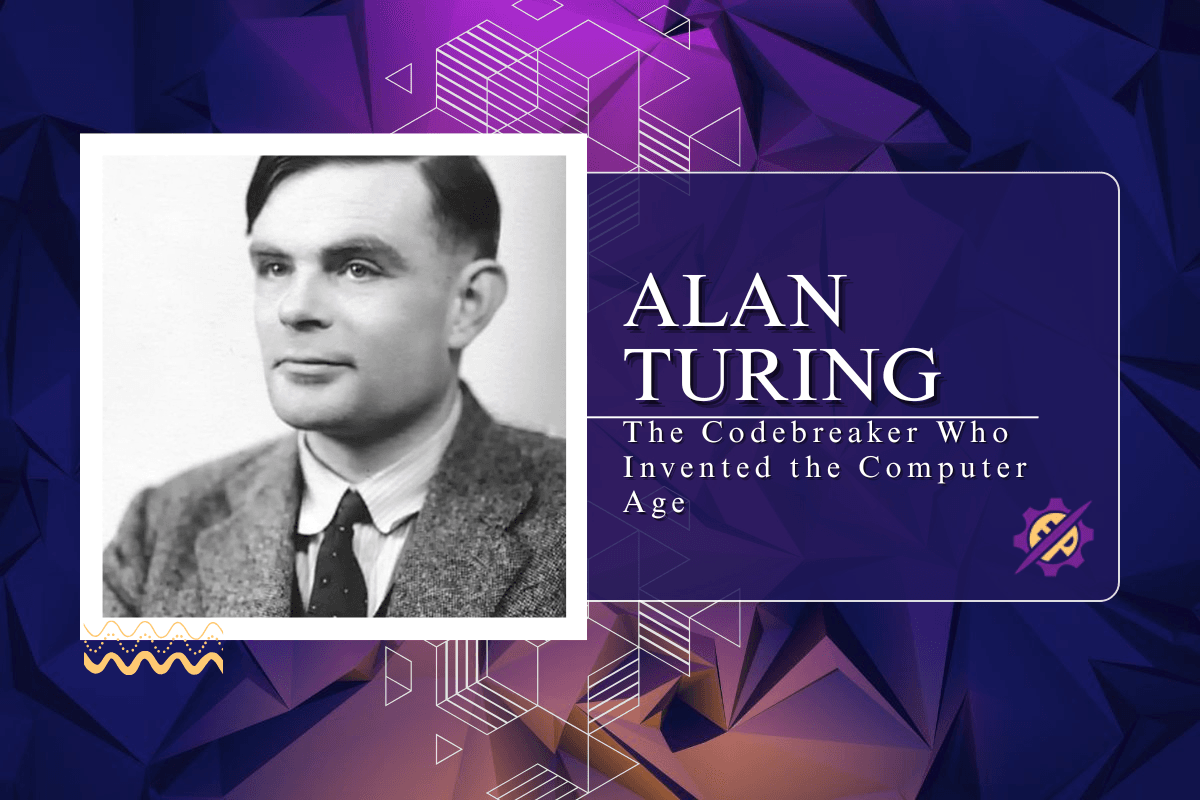
Alan Turing came up with the theoretical foundation for modern computing. He also helped win World War II by cracking Nazi codes. Then his own country prosecuted him for being gay, and he died at 41.
“We can only see a short distance ahead, but we can see plenty there that needs to be done.” – Alan Turing
Table of Contents
Before Modern Computing
In the 1930s, “computer” was a job title. It referred to people, usually women, who did calculations by hand. Machines existed that could do specific mathematical tasks, but nothing like what we have now. There was no concept of a programmable device that could be told to do different things.
Turing, a mathematician at Cambridge, started thinking about what a theoretical computing machine might look like.
“Sometimes it is the people no one imagines anything of who do the things no one can imagine.” – Alan Turing
Turing’s Major Contributions
The Turing Machine (1936)
Turing described a hypothetical device on paper. It could read symbols, follow instructions, and perform any calculation given the right program. This wasn’t a physical machine. It was a thought experiment. But it became the basis for how all computers work. The concept that one machine could be programmed to do many different tasks started with this paper.
Cracking Enigma (1939-1945)

The Germans used a machine called Enigma to encrypt military communications. The code changed every day. It was considered unbreakable. Turing and his team at Bletchley Park built a device called the Bombe that could rapidly test possible settings. They broke the code. Historians estimate this shortened the war by two to four years.
Early Computers (1945-1950)
After the war, Turing worked on real computing machines. He helped design the ACE at the National Physical Laboratory and later worked on the Manchester Mark 1, one of the first computers that could store programs in memory.
The Turing Test (1950)
Turing wrote a paper asking whether machines could think. He proposed a test: if a person can’t tell whether they’re communicating with a human or a machine, the machine could be considered intelligent. People still argue about this question today.
Effects of Turing’s Work
| Area | Contribution |
|---|---|
| Computing | The Turing machine concept is the basis for all programmable computers |
| Cryptography | Bletchley Park techniques influenced how encryption developed |
| Artificial Intelligence | The Turing test is still used to discuss machine intelligence |
| Software | The idea that one machine can run different programs came from Turing |
| Mathematics | His work defined which problems can and cannot be solved by machines |
The Team at Bletchley Park
Bletchley Park was a secret facility in the English countryside. Britain gathered mathematicians, linguists, and chess players there to break Axis codes. Turing arrived in 1939.
He worked with Gordon Welchman, who improved the Bombe design. Joan Clarke was a mathematician who collaborated with Turing directly on Enigma. Dilly Knox, an older codebreaker, trained many of the younger staff. Turing’s contributions were significant, but the work was a group effort.
Everything at Bletchley Park was classified for decades. Most people who worked there couldn’t discuss it until the 1970s. Turing died without any public credit for what he did during the war.
“No, I’m not interested in developing a powerful brain. All I’m after is just a mediocre brain, something like the President of the American Telephone and Telegraph Company.” – Alan Turing
Prosecution and Death
In 1952, Turing reported a burglary at his home. During the investigation, police discovered he was in a relationship with a man. Homosexuality was illegal in Britain at the time. Turing was charged with gross indecency.
He was offered a choice: prison or chemical castration. He chose the hormone treatment so he could keep working. The treatment caused physical changes and likely affected him mentally.
In 1954, Turing was found dead from cyanide poisoning. He was 41 years old. The official ruling was suicide, though some researchers think it may have been an accident.
Recognition Came Late
Turing got little recognition while he was alive.
In 2009, British Prime Minister Gordon Brown apologized publicly for how the government treated Turing. In 2013, Queen Elizabeth II granted him a posthumous pardon. In 2021, his face appeared on the £50 note.
The “Alan Turing law” refers to UK legislation that pardoned men convicted under old anti-homosexuality laws. The Turing Award, given each year by the Association for Computing Machinery, is considered the highest honor in computer science.
What He Left Behind
Turing’s 1936 paper described how computers would work before anyone built one. His 1950 paper asked questions about artificial intelligence that researchers are still trying to answer. His wartime work remained secret until long after his death.
Turing never saw computers become household items or his ideas become the foundation of an entire industry. He died before he could live openly as himself.
What’s Next?
Turing’s question about machine thinking is still unresolved. As AI gets more capable, how should we decide if a machine is actually intelligent? Is the Turing test still useful, or do we need something new?
For interesting engineering and science content, follow our Instagram page!
Have any thoughts?
Share your reaction or leave a quick response — we’d love to hear what you think!
-
 0
0 - 0
- 0



