
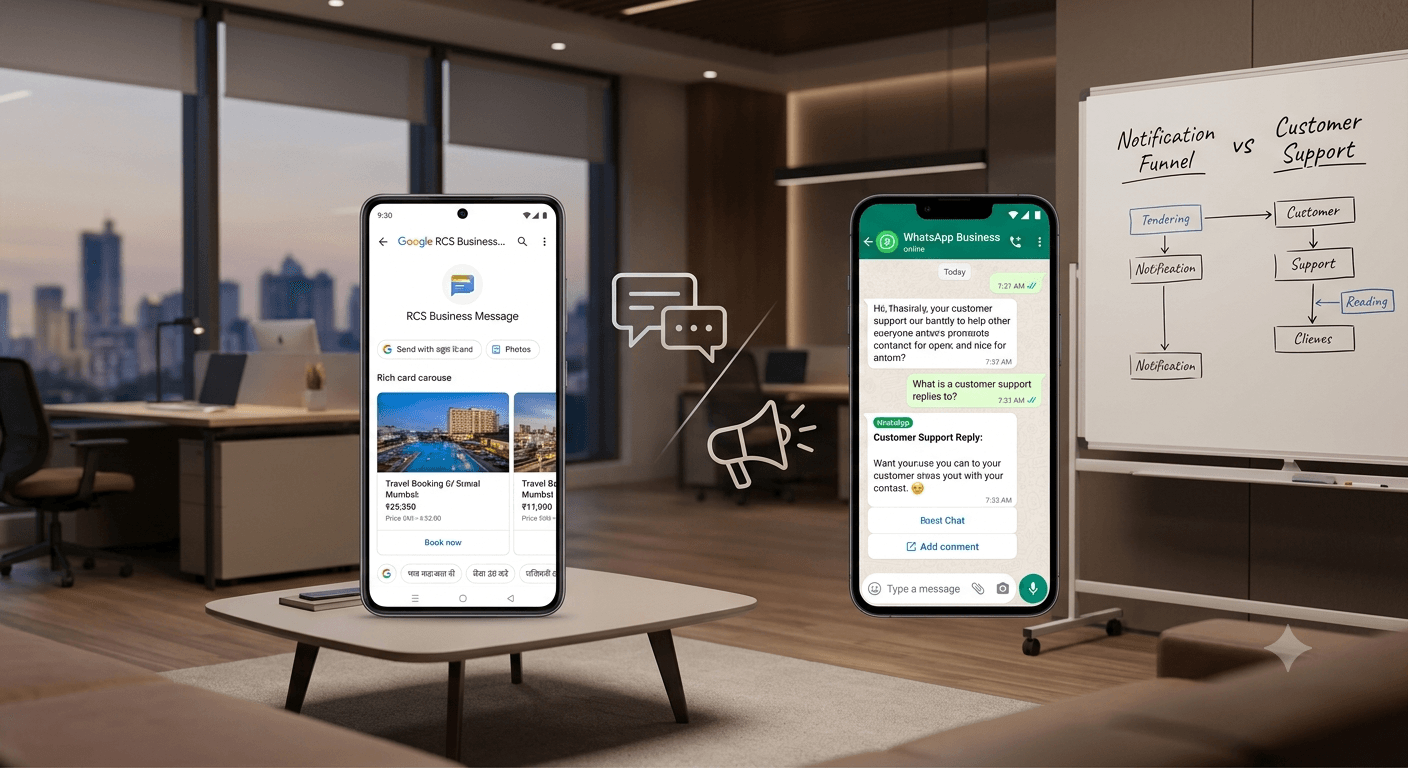
If your business is still treating SMS, WhatsApp and RCS as interchangeable messaging channels, 2026 is a good time to rethink that strategy.
Customers in India are already comfortable communicating with brands through their phones. They want order updates, appointment reminders, payment notifications, offers, customer support and product recommendations to arrive where they are already spending time. The real question for businesses is no longer “Should we use business messaging?”
It is:
“Which messaging channel should we use for which customer journey?”
That is where the RCS vs WhatsApp for Business debate gets interesting.
WhatsApp has an enormous advantage in familiarity and conversational behavior. Customers already know how to open a WhatsApp chat, reply to a business and share media or documents. RCS, meanwhile, is evolving into a richer, more branded alternative to traditional SMS, with interactive cards, suggested actions, media and business identity features.
So, RCS vs WhatsApp in India in 2026: which one should your business choose?
The short answer is: you probably shouldn’t choose just one.
For many Indian businesses, the strongest messaging strategy is going to be a combination of WhatsApp Business and RCS, with each channel used where it performs best.
Table of Contents
RCS vs WhatsApp for Business: The Quick Verdict
If you need a simple answer before diving into the details, here it is:
| Business requirement | Better choice |
|---|---|
| Conversational customer support | |
| Two-way customer conversations | |
| Existing customer relationships | |
| Rich branded promotional messages | RCS |
| SMS-like transactional communication | RCS |
| Interactive rich cards and suggested actions | RCS |
| Customers already familiar with your chat channel | |
| Brand-controlled messaging experience | RCS |
| Marketing + conversational commerce | |
| Reaching customers through the native messaging experience | RCS |
| Large-scale omnichannel strategy | Both |
The important distinction is that RCS and WhatsApp are not really identical products competing for exactly the same job.
WhatsApp is fundamentally a messaging ecosystem and conversational platform.
RCS for Business is an evolution of mobile messaging that gives brands a richer experience than conventional SMS.
Google’s current RCS for Business documentation describes support for rich cards, media, PDFs, suggested replies and suggested actions, along with branding, analytics and verified business identity features.
That difference matters.
What Is RCS Business Messaging?
RCS, or Rich Communication Services, is often described as the next generation of SMS.
That description is useful, but it doesn’t tell the whole story.
For businesses, RCS Business Messaging allows brands to create richer messaging experiences directly inside supported messaging clients. Instead of sending a plain text message containing a link, businesses can build experiences using rich media, cards, suggested replies and actions.
Think about the difference between:
“Your order #4582 has been shipped. Track here: example.com”
and a branded message containing:
Your order is on the way
📦 Wireless Earbuds Pro
Expected delivery: Tuesday
Track Order | View Details
The second experience feels much closer to an app interaction.
And that is exactly where RCS becomes interesting for Indian businesses.
Google’s RCS for Business platform currently supports rich cards, media, PDFs, suggested replies and suggested actions through its messaging API.
Why RCS matters for Indian businesses
India remains a mobile-first market, which makes messaging an important part of the customer journey.
A customer may discover a product on Instagram, search for the brand on Google, purchase through a website and then receive delivery updates on their phone.
RCS can potentially become the communication layer connecting those transactions with a richer native messaging experience.
For businesses that have historically depended heavily on SMS, this is particularly relevant.
Instead of abandoning SMS-style communication completely, brands can move toward a more visual, interactive experience.
What Is WhatsApp Business?
WhatsApp Business gives companies a way to communicate with customers through WhatsApp, one of the most familiar messaging environments for consumers in India.
Depending on the business setup and use case, companies can use WhatsApp for customer conversations, notifications, marketing communication, support and commerce experiences.
The biggest advantage is simple:
Customers already understand WhatsApp.
There is almost no learning curve.
If a business sends:
“Hi Rahul, your service appointment is confirmed for 4 PM tomorrow.”
the customer knows exactly what to do next.
They can reply.
They can ask another question.
They can send a photo.
They can continue the conversation.
That conversational nature is one of WhatsApp’s biggest strengths.
RCS vs WhatsApp: The Biggest Difference
The easiest way to understand the difference is to think about conversation versus communication experience.
WhatsApp is exceptionally strong when the customer needs to talk to your business.
RCS becomes particularly attractive when your business needs to deliver a branded, interactive message experience.
For example:
WhatsApp is a natural fit for:
- Customer support
- Product enquiries
- Sales conversations
- Lead nurturing
- Appointment discussions
- Conversational commerce
- Customer service
- Post-purchase conversations
- Sending documents and media
- Human + chatbot interactions
RCS can be a strong fit for:
- Order notifications
- Delivery updates
- Appointment reminders
- Promotional campaigns
- Product announcements
- Rich product cards
- Interactive CTAs
- Branded notifications
- Offers and campaigns
- Transactional communication
Of course, there is overlap.
That is why the decision shouldn’t be based on a simplistic “RCS vs WhatsApp” winner-takes-all comparison.
RCS vs WhatsApp for Business in India: Feature Comparison
Let’s compare the two channels across the factors that actually matter to marketers and business teams.
1. User Familiarity
WhatsApp: Excellent
This is probably WhatsApp’s biggest advantage.
Indian consumers don’t need to be educated about what WhatsApp is or how a WhatsApp conversation works.
That familiarity reduces friction.
A customer can see a message from a brand and immediately understand how to respond.
RCS: Growing
RCS has a different advantage: it can feel like a natural extension of the phone’s native messaging experience rather than requiring the customer to engage with a separate business messaging ecosystem.
Google describes RCS for Business as a way for brands to engage customers with rich media, branding, analytics and verified identity.
Winner: WhatsApp for familiarity
2. Rich Media and Interactive Messaging
This is where RCS becomes much more compelling than traditional SMS.
RCS supports formats such as rich cards, media, suggested replies and suggested actions.
That means a business can create a message that feels much more like a miniature interactive experience.
For an ecommerce company, that could mean:
- Product image
- Product name
- Price
- Description
- Buy button
- View product button
For a travel company:
- Destination image
- Flight information
- Booking details
- Check-in action
- Support option
For a bank:
- Transaction notification
- Account information
- Secure action
- Support pathway
WhatsApp also offers rich conversational experiences, making it extremely capable for businesses.
But RCS has a particularly strong proposition when the goal is to transform a notification into a richer branded interaction.
Winner: RCS for native rich messaging; WhatsApp for conversational richness
3. Customer Conversations
This is where WhatsApp shines.
Imagine a customer receiving an offer for a smartphone.
They reply:
“Does this come with a warranty?”
Then:
“What colours are available?”
Then:
“Can I get delivery tomorrow?”
That is a conversation.
WhatsApp is built around this behavior.
For customer support, lead qualification and sales conversations, WhatsApp can feel much more natural.
RCS can support replies and actions, but businesses evaluating RCS vs WhatsApp for customer service should pay close attention to the type of interaction they actually want.
If your KPI is:
“How many customers completed the desired action?”
RCS can be highly relevant.
If your KPI is:
“How effectively can we have an ongoing conversation with customers?”
WhatsApp is usually the more natural fit.
Winner: WhatsApp
4. Branding
Brand trust matters enormously in business messaging.
Nobody wants to wonder:
“Is this actually my bank?”
or:
“Is this really the airline?”
or:
“Is this message from the company I ordered from?”
RCS puts considerable emphasis on branded business identity. Google’s RCS for Business platform includes business branding and a verified icon as part of its positioning.
This can make a message feel more like an official communication than a generic text.
WhatsApp also provides a recognizable business environment, but the overall messaging experience is different.
Winner: RCS for branded messaging presentation
5. Transactional Messaging
Transactional communication is one of the most interesting areas for RCS.
Think:
- OTP notifications
- Order confirmations
- Shipping updates
- Delivery alerts
- Appointment reminders
- Payment notifications
- Booking confirmations
- Service updates
Businesses don’t necessarily need a long conversation here.
They need the customer to receive important information quickly and act on it when necessary.
A rich RCS message can potentially turn a simple notification into an actionable experience.
For example:
Your flight is tomorrow
Mumbai → Bengaluru
10:35 AM
[View Booking] [Check In]
That’s much more useful than a plain SMS containing several lines of text and a URL.
Winner: RCS for notification-led experiences
6. Marketing Campaigns
This one requires more nuance.
WhatsApp is already deeply embedded in digital marketing strategies across India because businesses can combine marketing with conversation.
A customer sees an offer.
They reply.
The business answers.
The customer purchases.
That creates a direct path from marketing to conversation to conversion.
RCS, meanwhile, can make promotional messaging visually richer.
A campaign might include:
Weekend Sale — Up to 50% Off
[Product image]
Shop men’s fashion
Shop women’s fashion
View all offers
The experience can feel more like an interactive campaign than a conventional text blast.
However, businesses should not interpret rich messaging as permission to send unlimited promotional content.
Google’s current RCS rules specifically include traffic limits for promotional RCS agents operating in India, with limits influenced by agent reputation over a rolling 28-day period.
That makes message quality, user relevance and reputation increasingly important.
Winner: Depends on campaign objective
7. Customer Support
For customer support, WhatsApp generally has the edge.
Why?
Because support is rarely a single-button interaction.
A customer might say:
“My order hasn’t arrived.”
The support system asks:
“Can you share your order number?”
The customer replies.
Then the agent asks for a photo.
Then the customer sends one.
This is exactly the kind of interaction messaging platforms are designed for.
WhatsApp’s conversational environment makes it a strong choice for support teams.
Winner: WhatsApp
8. Automation and Chatbots
Both channels can support automated experiences, but the implementation depends heavily on the provider, APIs, infrastructure and business use case.
For WhatsApp, companies commonly build:
- Chatbots
- Lead qualification flows
- Customer support bots
- Order tracking
- Payment journeys
- Appointment booking
- Product discovery
RCS can also connect to backend systems through its business messaging APIs. Google documents API-based sending, webhooks and event handling for RCS Business Messaging.
This makes RCS much more than a prettier SMS.
It can be integrated into an actual automated customer journey.
Winner: Tie — implementation matters more than the channel
RCS vs WhatsApp Pricing in India
Pricing is one area where businesses should avoid relying on generic internet comparisons.
Messaging costs can change based on:
- Country
- Message category
- Provider
- Traffic volume
- Campaign type
- Conversation type
- Platform policies
- Infrastructure
- Business solution provider
So instead of asking:
“Is RCS cheaper than WhatsApp?”
ask:
“Which channel produces the lowest cost per successful business outcome?”
That could be:
- Cost per qualified lead
- Cost per completed purchase
- Cost per resolved support ticket
- Cost per delivered notification
- Cost per appointment
- Cost per customer retained
A channel that costs slightly more per message but generates significantly more conversions may be cheaper from a business perspective.
That is the metric worth watching.
RCS vs WhatsApp Delivery and Reach in India
Reach is another area where marketers need to think beyond raw mobile numbers.
WhatsApp requires customers to use WhatsApp.
RCS depends on supported RCS capabilities and messaging environments.
Google’s current RCS for Business documentation emphasizes device capability verification and recommends businesses design their messaging around capability and message-size considerations.
That means an effective RCS strategy should not simply assume that every mobile number is automatically equivalent to a reachable RCS user.
For large businesses, this makes fallback strategy important.
Your messaging infrastructure should know:
- Who can receive RCS?
- Who should receive WhatsApp?
- Who requires SMS?
- Which channel has previously engaged with the customer?
- Which channel is appropriate for the message type?
This is where omnichannel messaging becomes much more powerful than choosing one platform.
RCS vs WhatsApp for Ecommerce Businesses
For ecommerce brands in India, both channels can play valuable roles.
Imagine an online fashion retailer.
RCS could handle:
Order confirmed
Your order #82731 is confirmed.
[View Order]
Out for delivery
Your package arrives today.
[Track Package]
Weekend Sale
Up to 60% off selected styles.
[Shop Now]
WhatsApp could handle:
Customer:
“Can I change the delivery address?”
Business:
“Sure. Please share your order number.”
Customer:
“82731.”
Business:
“Your order is eligible. Would you like to update it to your saved address?”
That is the distinction.
RCS can be fantastic for structured, action-oriented communication.
WhatsApp can be fantastic for conversations around that communication.
Using both creates a much stronger customer journey.
RCS vs WhatsApp for Banks and Financial Services
Financial services businesses need to be especially careful about security, trust, consent, regulatory requirements and customer protection.
The use case should determine the channel.
For example:
RCS
A bank could potentially use rich messaging for:
- Account alerts
- Transaction notifications
- Service reminders
- Product information
- Branch/service updates
It could use conversational messaging for:
- Customer support
- Product enquiries
- Service requests
- FAQs
- Guided assistance
But financial institutions should never treat the messaging channel itself as a substitute for proper authentication and security controls.
For regulated businesses, channel strategy needs to be designed alongside applicable regulatory and security requirements.
RCS vs WhatsApp for Travel and Hospitality
Travel is another industry where both channels make sense.
Imagine receiving:
Your flight is tomorrow
Mumbai → Delhi
Flight 6E 123
Departure: 8:40 AM
[View Booking] [Check In]
That’s a strong RCS-style notification use case.
But imagine the passenger responding:
“Can I change my seat?”
That becomes a conversational support use case where WhatsApp can be extremely useful.
Hotels have a similar opportunity.
RCS
- Booking confirmation
- Check-in reminder
- Reservation details
- Promotional offer
- Room upgrade offer
- “Can I request late checkout?”
- “Can you arrange airport pickup?”
- “Where is the hotel?”
- “Can I change my reservation?”
Again, the winner isn’t necessarily one channel.
The winner is the right channel for the customer’s intent.
RCS vs WhatsApp for Small Businesses in India
Small businesses shouldn’t overcomplicate this.
If you’re a local retailer, clinic, salon, restaurant, coaching business or service provider and most of your customers already communicate with you on WhatsApp, start there.
The biggest mistake a small business can make is adopting technology because it sounds impressive rather than because customers actually need it.
WhatsApp is often the simpler starting point for:
- Customer enquiries
- Appointment booking
- Lead follow-up
- Support
- Product questions
- Repeat purchases
RCS becomes more interesting as messaging volume, automation and transactional communication become more important.
In other words:
Start with the channel your customers already use. Add RCS when it solves a specific business problem.
RCS vs WhatsApp: Which Is Better for Marketing?
There isn’t a universal winner.
But there is a useful way to think about it.
Choose WhatsApp when your marketing strategy depends on conversation.
For example:
Ad → WhatsApp → Product enquiry → Sales agent → Purchase
Choose RCS when your strategy depends on rich, action-oriented messaging.
For example:
Customer database → Branded RCS message → Product card → CTA → Website/app
Use both when you want the strongest funnel.
For example:
RCS notification → Customer clicks → WhatsApp support → Purchase
This is where modern messaging strategies are heading.
The question isn’t:
“Which messaging app should replace the other?”
It’s:
“Which channel should handle each stage of the customer journey?”
RCS vs WhatsApp for Business: Advantages and Disadvantages
RCS Advantages
- Rich media messaging
- Branded messaging experience
- Rich cards
- Suggested replies
- Suggested actions
- Native messaging experience
- Strong potential for transactional communication
- Useful for interactive notifications
- Can support analytics and delivery events
- API-based business integration
Google’s documentation specifically highlights rich media, branding, analytics and verified identity for RCS for Business.
RCS Disadvantages
- Reach depends on supported capabilities
- Businesses need proper technical implementation
- Promotional traffic rules apply
- Customer experience can vary by device and messaging environment
- Requires careful fallback planning
- RCS adoption is still different from WhatsApp’s established consumer behavior
India-specific promotional RCS traffic limits introduced in 2026 make reputation and campaign quality particularly important for businesses sending promotional traffic at scale.
WhatsApp Advantages
- Extremely familiar to consumers
- Excellent conversational experience
- Strong customer support use case
- Useful for sales conversations
- Good fit for conversational commerce
- Rich media capabilities
- Strong ecosystem for business messaging
- Suitable for chatbots and automation
WhatsApp Disadvantages
- Requires customers to use WhatsApp
- Businesses need to follow WhatsApp’s business and messaging policies
- Marketing communication needs careful consent and relevance management
- Costs and messaging rules can vary by use case
- It is not always the ideal channel for every transactional notification
WhatsApp’s own business messaging policy emphasizes rules governing business communications and how the platform applies those policies.
Should You Choose RCS or WhatsApp in 2026?
Here’s the practical answer.
Choose WhatsApp if:
Your business depends heavily on:
- Customer conversations
- Support
- Lead generation
- Sales follow-up
- Conversational commerce
- Human-assisted chat
- Customer relationship building
WhatsApp should probably be one of your core messaging channels.
Choose RCS if:
Your business needs:
- Rich transactional messages
- Branded notifications
- Interactive product cards
- Rich promotional experiences
- Action-oriented messaging
- An upgrade from conventional SMS
- Native messaging-based customer journeys
RCS deserves serious consideration.
Choose Both if:
You’re operating at scale.
For many enterprises, this is likely to be the smartest approach in 2026.
Use RCS for structured notifications and rich messaging experiences.
Use WhatsApp for conversations, support and commerce.
Use SMS or another fallback channel where appropriate.
Then connect everything to the same customer data and engagement layer.
The Real Winner: An Omnichannel Messaging Strategy
The biggest mistake businesses make with messaging is thinking in terms of platforms instead of customer journeys.
A customer doesn’t care whether your message was sent through RCS or WhatsApp.
They care whether the message:
- Arrived on time
- Was relevant
- Was easy to understand
- Felt trustworthy
- Gave them the right next step
- Let them get help when needed
That means your messaging architecture should start with the customer journey, not the technology.
For example:
Step 1: Purchase
Customer completes an order.
Step 2: Confirmation
Send an immediate transactional message through the most appropriate available channel.
Step 3: Shipping
Send a rich delivery update with a clear tracking action.
Step 4: Customer question
Move the customer into a conversational support channel.
Step 5: Delivery
Send a delivery confirmation.
Step 6: Retention
Later, use a relevant promotional campaign based on customer behavior and consent.
That’s a far more sophisticated strategy than simply saying:
“We use WhatsApp.”
or:
“We use RCS.”
RCS vs WhatsApp in India: What Should Marketers Measure?
Don’t judge your messaging strategy using open or delivery rates alone.
Track business outcomes.
Some of the most useful metrics include:
Delivery rate
Did the message actually reach the customer?
Read rate
Did the customer see it?
Click-through rate
Did the customer take the intended action?
Reply rate
Did the customer start a conversation?
Conversion rate
Did the message generate the desired business result?
Cost per conversion
How much did it cost to generate that result?
Revenue per message
How much revenue did the campaign generate relative to messaging volume?
Opt-out rate
Are customers getting too many messages?
Customer satisfaction
Did the communication actually improve the customer experience?
These metrics tell you far more than simply comparing RCS and WhatsApp on message volume.
The Future of Business Messaging in India
The direction of business messaging is becoming clear.
Customers don’t want more messages.
They want better messages.
A plain notification is useful.
A relevant notification with context and a clear action is better.
A notification that allows the customer to solve a problem without opening another app is better still.
That’s why RCS is worth watching closely in India.
Google’s current platform supports increasingly sophisticated rich messaging capabilities, including rich cards, media, suggested actions and event-driven integrations.
At the same time, WhatsApp’s strength remains its enormous conversational value.
So the future isn’t necessarily RCS replacing WhatsApp.
It’s much more likely to be RCS and WhatsApp becoming different pieces of a broader customer communication strategy.
Final Verdict: RCS vs WhatsApp for Business in India in 2026
If you’re looking for a single winner, you’re asking the wrong question.
WhatsApp wins when conversation is the priority.
RCS wins when rich, branded and action-oriented messaging is the priority.
And for enterprises that communicate with customers at multiple stages of the funnel, using both can be more effective than forcing everything through one channel.
A useful rule of thumb is:
RCS for rich notifications. WhatsApp for rich conversations.
That simple distinction can help businesses decide where to invest without getting distracted by platform hype.
In 2026, the smartest messaging strategy isn’t about choosing the trendiest channel.
It’s about delivering the right message, through the right channel, at the right moment.
And in India’s increasingly mobile-first customer journey, that means RCS and WhatsApp both have a seat at the table.
Have any thoughts?
Share your reaction or leave a quick response — we’d love to hear what you think!
-
 0
0 - 0
- 0



