
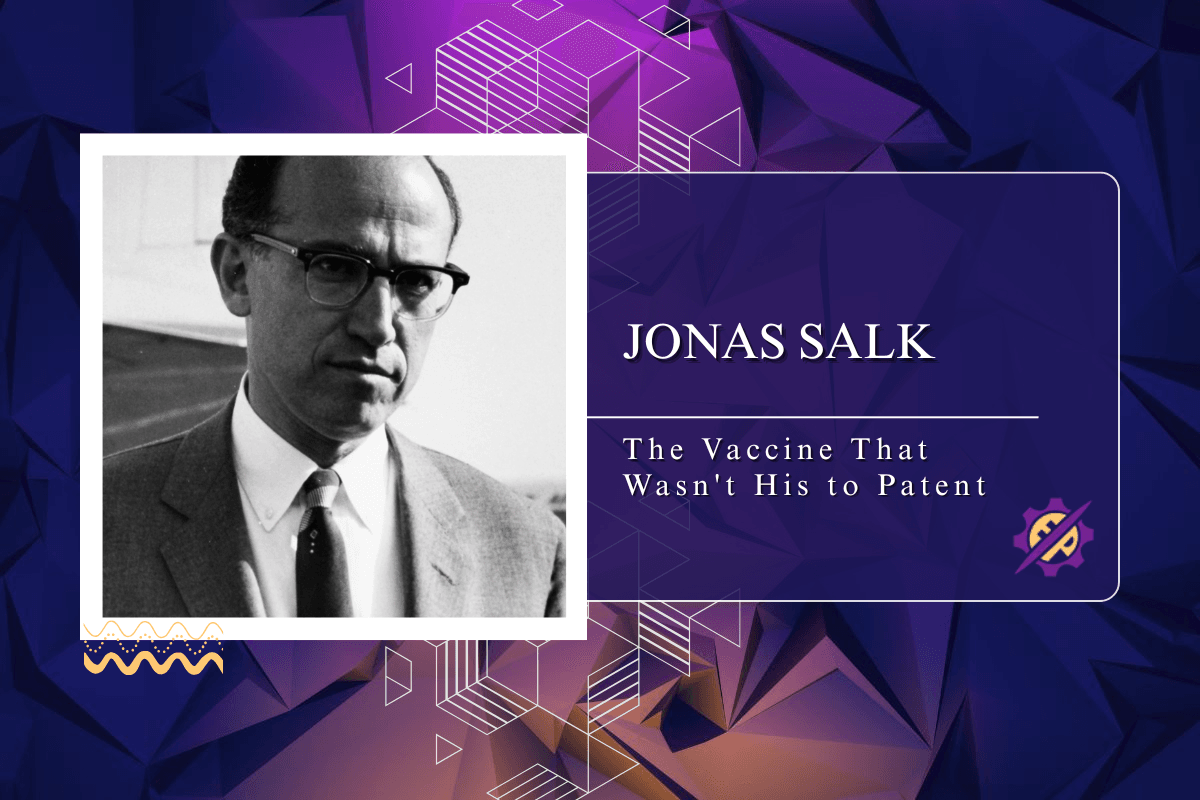
On April 12, 1955, CBS broadcaster Edward R. Murrow asked Jonas Salk who owned the patent to his polio vaccine. Salk’s answer became one of the most quoted lines in medical history: “Well, the people, I would say. There is no patent. Could you patent the sun?”
The quote has been repeated ever since by people arguing against pharmaceutical patents. But lawyers for the National Foundation for Infantile Paralysis had already looked into patenting the vaccine and concluded it wouldn’t qualify—Salk’s techniques built on discoveries made by others, and patent law required novelty. Whether Salk knew this when he spoke to Murrow remains unclear.
The vaccine worked, it was safe, and it reached people who needed it.
Table of Contents
Polio in the 1950s
In the early 1950s, polio terrified American parents more than almost anything except nuclear war. The disease struck without warning, mostly in summer, mostly children. Most infections caused mild symptoms or none at all. But in some cases, the virus attacked the spinal cord, leaving victims paralyzed or unable to breathe without an iron lung.

The numbers from 1952, the worst year:
| Statistic | Number |
|---|---|
| Total US cases reported | 57,628 |
| Deaths | 3,145 |
| Permanently paralyzed | 21,269 |
| Peak age group | Children 5-9 |
Franklin D. Roosevelt had contracted polio in 1921, at age 39. In 1938, he founded the National Foundation for Infantile Paralysis, which ran the March of Dimes fundraising campaign. By 1955, funding for polio research had reached $67 million per year, most of it collected in literal dimes from ordinary Americans.
Salk’s Background
Jonas Salk was born in New York City on October 28, 1914, the son of Russian-Jewish immigrants. He was the first in his family to attend college. At NYU medical school, he became interested in a question: why did vaccines for some diseases require live viruses while others used killed viruses?
At the University of Michigan, working under Thomas Francis, Salk helped develop a killed-virus influenza vaccine for the US Army during World War II. This gave him confidence that a killed-virus approach could work for polio too—even though most virologists at the time believed only live-virus vaccines could provide lasting immunity.
Vaccine Development at Pittsburgh
In 1947, Salk took a position at the University of Pittsburgh’s Virus Research Laboratory. The National Foundation gave him funding to study polio. He spent years on the problem: growing the virus, killing it with formaldehyde in a way that preserved its ability to trigger an immune response, testing and retesting.
By 1953, he was confident enough to vaccinate himself, his wife, and their three sons.
1954 Field Trial
The 1954 field trial remains the largest vaccine trial in history.
| Trial Component | Number |
|---|---|
| Total children participating | 1.8 million |
| Children receiving vaccine | 420,000+ |
| Children receiving placebo | 200,000+ |
| Children in observation group | ~1.2 million |
| Volunteer doctors, nurses, educators | 325,000 |
| States participating | 44 |
The children who participated became known as “Polio Pioneers.” Each received a pin and a certificate. The trial was double-blind in the vaccinated areas—neither the children nor the doctors knew who received vaccine or placebo. All the data was tracked by hand, on paper, processed partly by punch cards fed into room-sized computers.
Thomas Francis, Salk’s former mentor at Michigan, oversaw the evaluation. On April 12, 1955, at the University of Michigan, he announced the results: the vaccine was safe and 80-90% effective against paralytic polio.
Church bells rang across the country, and newspapers compared the announcement to V-E Day.
The Cutter Manufacturing Disaster
Two weeks later, reports emerged of children developing polio after vaccination. All the cases traced to vaccine manufactured by Cutter Laboratories in California.
The Cutter incident:
- 120,000 children received vaccine containing live poliovirus
- 40,000 developed abortive polio (mild, short-lived form)
- 56 to 200 were paralyzed (sources vary)
- 10 died
- The virus spread to family members and contacts, causing additional cases
The problem was manufacturing, not Salk’s formula. Cutter had failed to fully inactivate the virus in some batches. Federal oversight had been inadequate. The vaccine program was suspended for weeks, then resumed with stricter safety protocols.
Salk was exonerated. But the incident damaged public confidence in his vaccine and gave ammunition to critics who favored Albert Sabin’s competing live-virus oral vaccine, which came into use in 1961.
The Vaccine’s Impact
Between 1955 and 1962, US polio cases dropped from 45,000 per year to 910. By 1959, 90 countries were using Salk’s vaccine. By 1979, the last case of wild poliovirus was reported in the United States.
Scientific Recognition
Salk’s relationship with the scientific establishment never recovered from the fame. His colleagues resented the publicity, the television appearances, the photos with celebrities. They considered his work applied science rather than basic discovery—he had combined existing techniques rather than inventing something new.
The scientific establishment honored him with the Albert Lasker Award in 1956, and the government gave him the Presidential Medal of Freedom and the Congressional Gold Medal. But he never received the Nobel Prize, and the National Academy of Sciences never admitted him to membership.
Sven Gard, the Swedish virologist who influenced the Nobel Committee, wrote in his 1956 evaluation that Salk “has not in the development of his methods introduced anything that is principally new, but only exploited discoveries made by others.” The 1954 Nobel Prize in Physiology or Medicine went instead to John Enders, Thomas Weller, and Frederick Robbins, who had discovered how to grow poliovirus in tissue culture—the breakthrough that made Salk’s work possible.
The Salk Institute in La Jolla
In 1960, the city of San Diego gave Salk 27 acres on a mesa overlooking the Pacific Ocean in La Jolla. He partnered with architect Louis Kahn to design a research center. His instructions to Kahn: “Create a facility worthy of a visit by Picasso.”
The Salk Institute opened in 1963—two mirror-image concrete buildings framing a travertine courtyard with a narrow channel of water pointing toward the ocean. The design was influenced by the monastery of St. Francis of Assisi. Twice a year, on the spring and fall equinoxes, the setting sun aligns directly with the water channel.
The Institute was built with $20 million from the National Science Foundation and support from the March of Dimes. Among its first fellows were Francis Crick (co-discoverer of DNA’s structure) and Leo Szilard (the physicist who had drafted Einstein’s letter urging FDR to build the atomic bomb).
Salk spent his last years at the Institute working on an AIDS vaccine. He did not succeed. He died on June 23, 1995, at age 80.
The Salk Institute remains one of the world’s leading biomedical research centers and has hosted multiple Nobel laureates since its founding.
Check out our Instagram for even more fascinating figures!
Have any thoughts?
Share your reaction or leave a quick response — we’d love to hear what you think!
-
 0
0 - 0
- 0



