
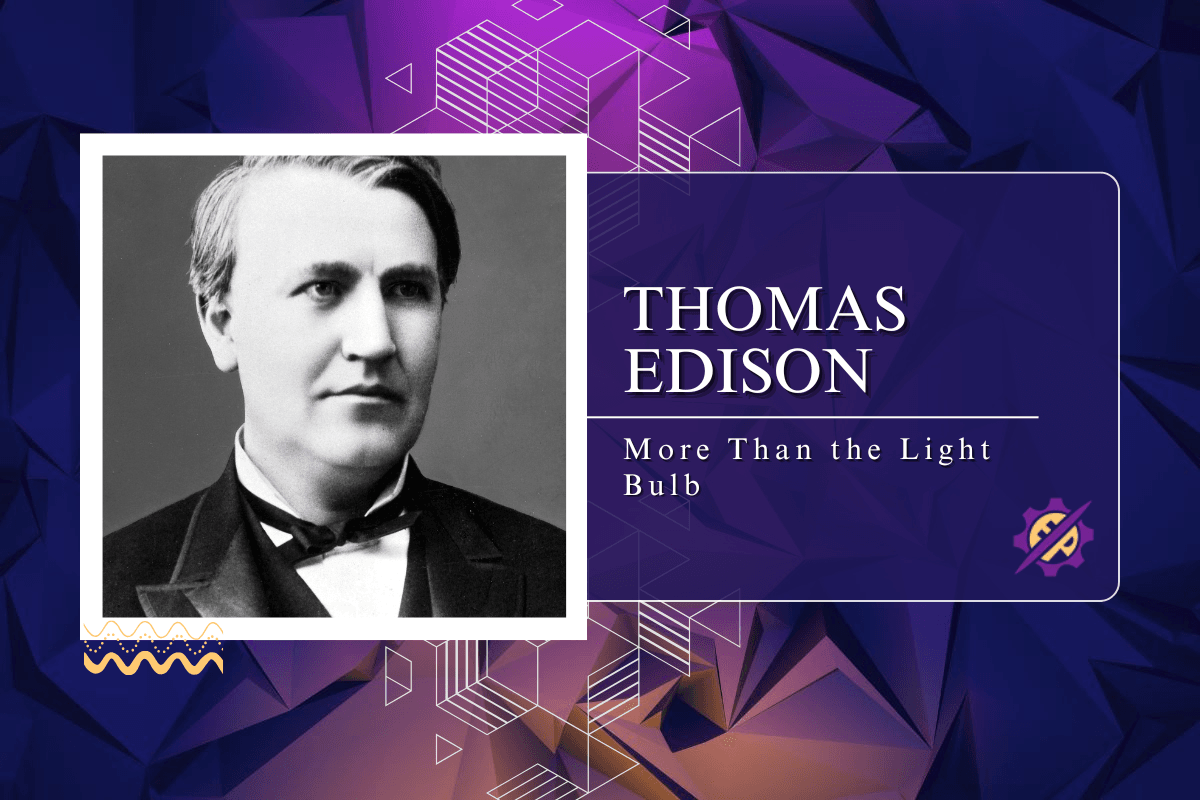
Thomas Edison held 1,093 patents. He gave us the phonograph, improved the light bulb, and built the first commercial electric power system. But his biggest contribution wasn’t any single invention. It was the idea that invention itself could be a business.
Table of Contents
Not the Light Bulb
Edison didn’t invent the light bulb. By the time he started working on it in 1878, at least 20 other inventors had created working incandescent lamps. What Edison did was make one that lasted.
The problem with early light bulbs was the filament. It would burn out in minutes or hours. Edison and his team tested thousands of materials. They tried platinum, carbonized paper, various woods, and eventually settled on carbonized bamboo from Japan. That filament lasted over 1,200 hours.
But a light bulb by itself was useless. People needed electricity to power it. So Edison built that too.
The Whole System
Edison didn’t just sell light bulbs. He built power stations, wiring systems, meters, and switches. In September 1882, he opened the Pearl Street Station in lower Manhattan, the first commercial electrical power plant in the United States. On its first day, it powered 82 customers and 400 lamps. By 1884, it served 508 customers with over 10,000 lamps.
Within a few years, Edison had power stations running in several cities. He built an industry where none had existed.
“Genius is one percent inspiration and ninety-nine percent perspiration.” – Thomas Edison
The Invention Factory
Before Edison, inventors worked alone or in small groups. Edison changed that.
In 1876, he built a laboratory in Menlo Park, New Jersey. He called it an “invention factory.” He hired machinists, chemists, mathematicians, and craftsmen. They worked on multiple projects at once, and Edison pushed them hard. The goal was to produce “a minor invention every ten days and a big thing every six months or so.”
The approach worked:
- 1877 – Phonograph (first device to record and play back sound)
- 1879 – Practical incandescent light bulb
- 1882 – First commercial power station
- 1891 – Kinetoscope (early motion picture device)
- 1896 – Fluoroscope (improved X-ray machine)
Menlo Park became the model for corporate research labs. Bell Labs, which produced the transistor and the laser, was built on Edison’s idea.
How He Actually Worked

Edison was a tireless worker who sometimes slept in his lab. He was also ruthless about taking credit.
The phonograph was genuinely his idea. The light bulb was a team effort that Edison marketed as his own. The motion picture camera was largely developed by his employee William Kennedy Dickson, though Edison’s name went on the patents.
Edison also fought dirty. When Nikola Tesla’s alternating current threatened his direct current power system, Edison backed public demonstrations where animals were electrocuted with AC to prove it was dangerous. He lost that fight. AC became the standard.
The Numbers
| Category | Edison’s Record |
|---|---|
| US Patents | 1,093 |
| Foreign Patents | 1,239 more (2,332 total worldwide) |
| Menlo Park output | 400 patents in 6 years |
| Peak year | 1882: 106 patent applications |
| Lab notebooks | Over 4,000 |
What Got Left Behind
Edison worked on electric cars in the early 1900s. The batteries weren’t good enough, and gasoline won. He spent years trying to make concrete houses cheap enough for working families. The idea never caught on. He invested heavily in iron ore mining and lost most of the money.
Not every invention worked. Edison knew that.
“I never did anything by accident, nor did any of my inventions come by accident; they came by work.” – Thomas Edison
Edison died in 1931 at age 84. By then, electricity had transformed daily life. Recorded music was a major industry. Motion pictures were a global phenomenon. The research laboratory had become standard practice for large companies.
He didn’t invent everything he’s credited with. But he figured out how to organize invention, fund it, and scale it up.
For interesting engineering and science content, follow our Instagram page!
Have any thoughts?
Share your reaction or leave a quick response — we’d love to hear what you think!
-
 0
0 - 0
- 0



