
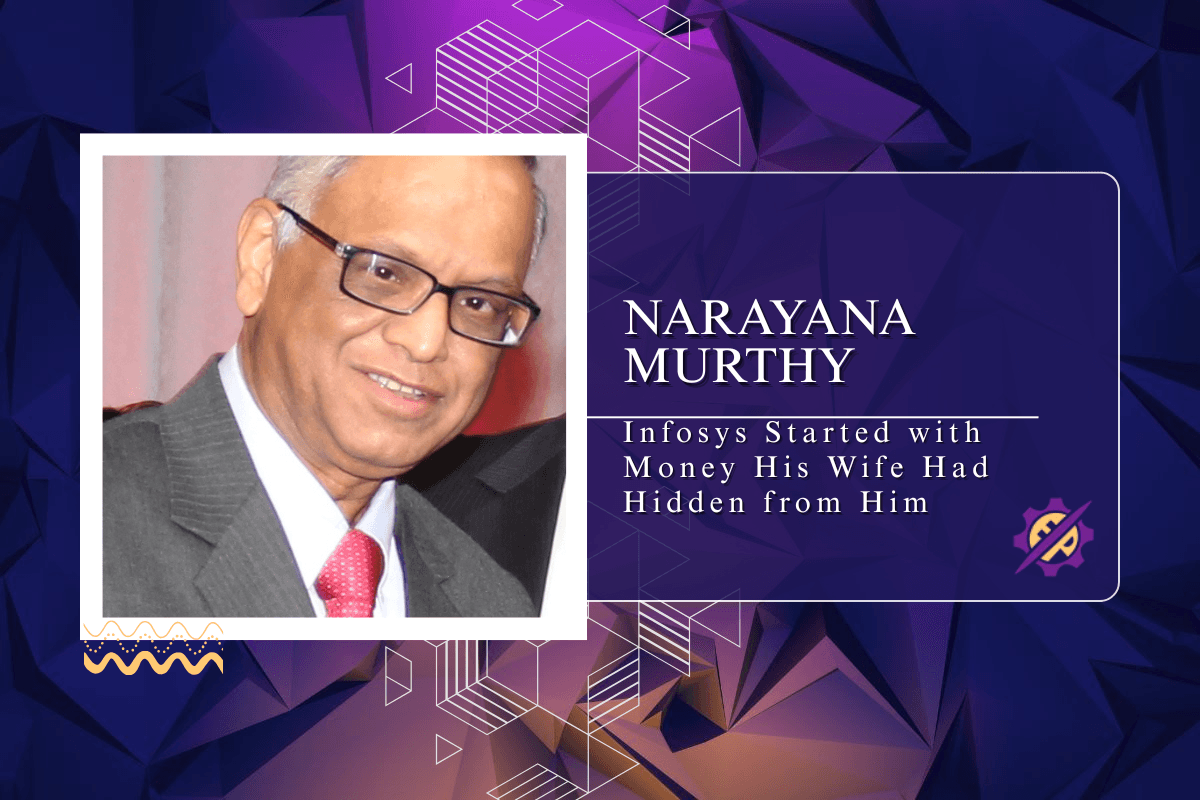
In 1981, seven engineers in Pune, India, decided to start a software company. None of them had any money. Narayana Murthy, the oldest at 35, went to his wife Sudha and asked if she had anything saved.
She did. Without telling him, she had been setting aside money from her salary at Tata Industries. She handed him 10,000 rupees—the equivalent of a few hundred dollars.
Their first office was the front room of Murthy’s apartment. Sudha cooked for the team and worked as their secretary while holding down her full-time job.
Today Infosys employs more than 300,000 people and is worth over $70 billion. It was the first India-registered company listed on NASDAQ. It created thousands of millionaires through employee stock options, a concept almost unknown in India before Murthy introduced it.
Table of Contents
The Seven Founders
| Founder | Role at Infosys | Background |
|---|---|---|
| N. R. Narayana Murthy | CEO (1981–2002), Chairman (2002–2011) | IIT Kanpur, worked in Paris |
| Nandan Nilekani | CEO (2002–2007), later founded Aadhaar | IIT Bombay |
| Kris Gopalakrishnan | CEO (2007–2011) | IIT Madras |
| S. D. Shibulal | CEO (2011–2014) | IIT Madras |
| K. Dinesh | Head of quality and information systems | University of Mysore |
| N. S. Raghavan | Joint managing director | IIM Ahmedabad |
| Ashok Arora | Left in 1989 | — |
All seven came from middle-class families. None had connections to wealth or political power.
Arrested in Bulgaria for Making Conversation
Before Infosys, Murthy was a self-described “confused leftist.”
In the early 1970s, he worked in Paris designing software for Charles de Gaulle Airport. In 1974, he decided to travel home overland through Eastern Europe. On a train from Yugoslavia to Bulgaria, he struck up a conversation in French with a young woman about life under communism. The man accompanying her called the police.
Bulgarian guards pulled Murthy off the train, confiscated his passport and luggage, and threw him in an 8-by-8-foot cell with no bed. Nobody brought food or water. After about 72 hours, they dragged him to a platform and shoved him into the guard’s compartment of a freight train headed for Turkey.
“Look, you are from a friendly country called India,” they told him, “so we are letting you go. We will give you your passport when you reach Istanbul.”
“If a country treats friends like this,” he thought, “I never want to be part of a communist country.”
The experience, he said later, turned him into a “compassionate capitalist.”
When They Almost Sold for $1 Million
After nine years, Infosys was still struggling. India’s economy was heavily regulated. Getting a telephone line took years. Importing a computer required dozens of approvals. International travel was restricted.
Then came an offer: $1 million to sell the company.
On a Saturday morning in winter 1990, five of the six remaining founders met in their small Bangalore office. (Ashok Arora had left the previous year.) For four hours, Murthy stayed silent while his younger partners discussed whether to take the money.
When it was finally his turn to speak, he said he believed they were at the darkest hour before the dawn. If anyone wanted out, he would buy their shares himself.
No one left.
“In the seventeen years since that day,” Murthy said in 2007, “Infosys has grown to revenues in excess of $3 billion, a net income of more than $800 million, and a market capitalization of more than $28 billion—28,000 times richer than the offer of $1 million.”
What Changed in 1991
The Indian government liberalized the economy. Import restrictions loosened. Licensing requirements eased. Travel became simpler.
Infosys was positioned to take advantage. The company had spent a decade learning how to work with foreign clients under impossible conditions. Now those conditions were merely difficult.
| Year | Milestone |
|---|---|
| 1981 | Founded in Pune with Rs 10,000 |
| 1983 | Moved headquarters to Bangalore |
| 1993 | IPO on Bombay Stock Exchange; introduced employee stock options |
| 1999 | First India-registered company on NASDAQ; revenue ~$121 million |
| 2004 | First Indian IT company to exceed $1 billion in annual revenue |
| 2006 | Murthy retires as chairman; 70,000 employees, $3 billion revenue |
| 2021 | Market cap reaches $100 billion |
How the Global Delivery Model Worked
Murthy’s key innovation was what he called the Global Delivery Model.
The idea: divide software projects into pieces that could be done anywhere, then do the labor-intensive work in India where costs were lower, while keeping client-facing work close to the customer.
Making it work meant solving several problems at once. Telecommunications between India and the West barely existed in the 1980s. Processes had to be standardized so work could move between teams. Teams in different time zones had to hand off to each other seamlessly, creating a 24-hour workday. Everything had to be documented obsessively.
The model became the foundation of India’s entire IT outsourcing industry. When other Indian companies replicated it, Murthy didn’t complain. He saw it as validation.
Stock Options Made Ordinary Employees Rich

In 1993, Infosys went public in India and introduced employee stock options. This was almost unheard of in Indian business at the time.
When Infosys listed on NASDAQ in 1999 at $34 per share, ordinary employees became wealthy. Not just the founders—the engineers, the project managers, the early hires who had taken a chance on a small company.
Murthy has said that Infosys created over 2,000 dollar-millionaires and 20,000 rupee-millionaires.
He later expressed regret that he hadn’t given stock to even more early employees.
Rules the Founders Made for Themselves
The founders agreed on several principles early on:
No nepotism. None of their spouses or children would work for Infosys. (Murthy later said he regretted this—he should have let Sudha join.)
No vulgar display of wealth. Murthy lived in the same middle-class Bangalore neighborhood for decades, even as his net worth grew into the billions.
Transparency. Infosys was one of the first Indian companies to report financials in U.S. GAAP standards, making its books directly comparable to American companies.
Walking away from bad deals. In 1994, when General Electric tried to renegotiate rates downward, Murthy refused. He didn’t want Infosys to become dependent on any single client.
In His Own Words
On capitalism:
“The best way to make capitalism attractive is that corporate leaders exercise self-restraint in their perks, profligacy, compensation, and their lifestyle.”
On leadership:
“Leadership is about doing the right thing, even if it is going against a vast number of naysayers and mediocre people.”
On ideas:
“Ideas are a commodity. Execution of them is not.”
On change:
“Growth is painful. Change is painful. But nothing is as painful as staying stuck where you do not belong.”
On the Bulgarian guards:
“Deep in my heart, I always thank them for transforming me from a confused leftist into a determined, compassionate capitalist.”
Fighting with His Own Company
In 2017, Murthy publicly raised concerns about corporate governance at Infosys—the company he founded. He questioned severance packages for departing executives and the acquisition of an Israeli automation company. The board denied any lapses. The dispute became public and messy before eventually settling down.
Where He Stands Now
Murthy is 78. His net worth is around $5 billion. He sits on the boards of the Ford Foundation, the UN Foundation, and the Rhodes Trust.
Infosys is no longer his company to run. But the model he built—Indian engineers serving global clients through disciplined processes and distributed teams—became the template for an industry that now employs millions.
In 1990, someone offered him $1 million for everything. He said no.
For interesting engineering and science content, follow our Instagram page!
Have any thoughts?
Share your reaction or leave a quick response — we’d love to hear what you think!
-
 0
0 - 0
- 0



