
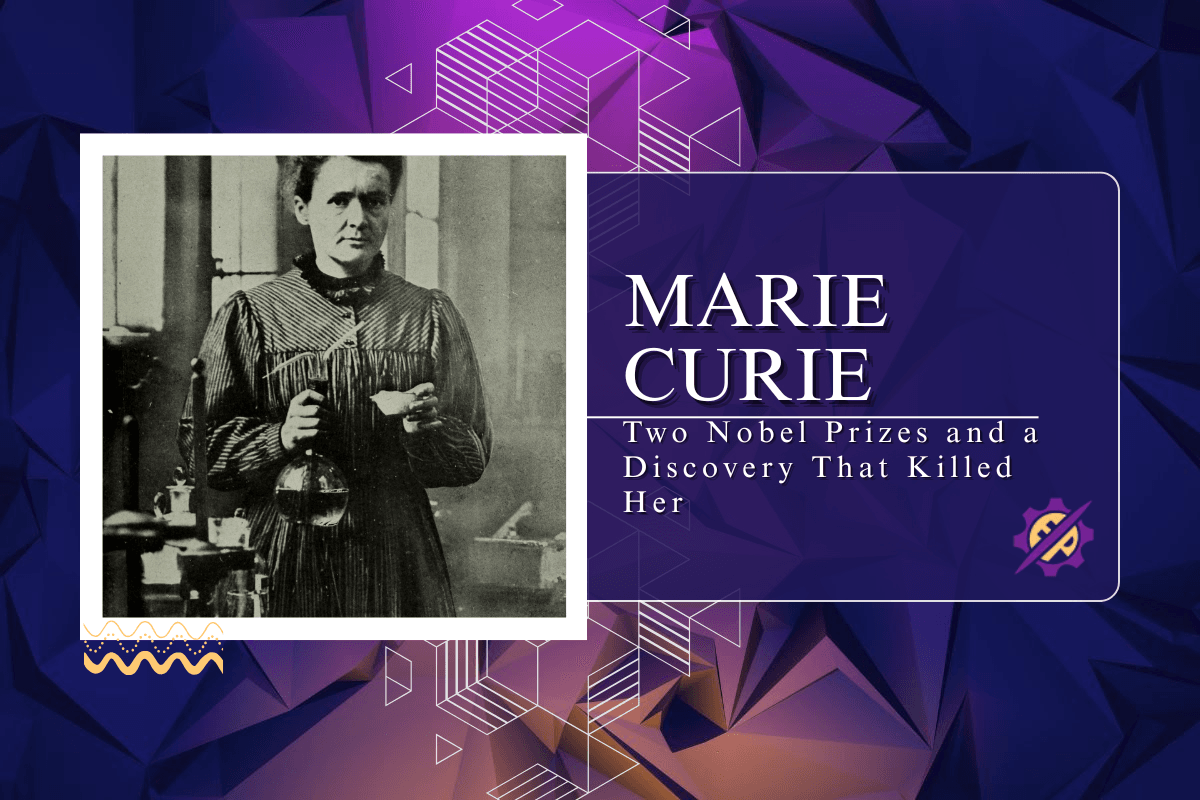
Marie Curie discovered two elements, coined the term “radioactivity,” and became the first woman to win a Nobel Prize. Then she won another one. The radiation she worked with for decades made her sick and eventually killed her. Her notebooks are still too radioactive to handle without protection.
“Nothing in life is to be feared, it is only to be understood.” – Marie Curie
Table of Contents
A Difficult Start
Maria Sklodowska was born in Warsaw in 1867 when Poland was under Russian control. Women weren’t allowed to attend university there. She worked as a governess for years, sending money to her sister in Paris. The deal was that her sister would return the favor once she finished medical school.
In 1891, at age 24, Curie finally made it to Paris and enrolled at the Sorbonne. Life there was not easy:
- She studied physics and mathematics while barely able to afford food
- She lived in a tiny sixth-floor apartment with no heat
- She sometimes fainted from hunger during lectures
She graduated first in her physics degree in 1893.
Meeting Pierre
Marie met Pierre Curie in 1894. He was already an established physicist working on magnetism and crystal structures. They married in 1895. Instead of a wedding dress, Marie wore a dark blue outfit she could later use in the laboratory.
They worked as partners from the start. Pierre gave up his own research to help Marie investigate the strange rays coming from uranium. When they won the Nobel Prize in Physics in 1903, Pierre insisted that Marie be named as a co-recipient. The committee had originally planned to leave her out.
“Be less curious about people and more curious about ideas.” – Marie Curie
The Discovery of Radioactivity
Curie didn’t discover that uranium emitted rays. Henri Becquerel found that in 1896. What Curie did was figure out that the rays came from the uranium atoms themselves, not from some chemical reaction. It meant that atoms weren’t solid, stable things. They could break apart and release energy.
She also noticed that pitchblende, the ore that contains uranium, was more radioactive than pure uranium. Something else had to be in there.
Finding Polonium and Radium

Curie and her husband spent four years processing tons of pitchblende in a leaky shed with no proper lab equipment. The process involved:
- Grinding and dissolving the ore
- Stirring boiling mixtures in huge vats by hand
- Handling radioactive materials without any protection
- Repeating the process thousands of times to isolate tiny amounts
In 1898, they announced two new elements:
| Element | Year | Named After |
|---|---|---|
| Polonium | 1898 | Poland, Marie’s home country |
| Radium | 1898 | Latin word for “ray” |
Radium glowed in the dark. Companies started putting it in watches, toothpaste, and health tonics. Nobody understood yet how dangerous it was.
After Pierre
Pierre Curie died in 1906 when a horse-drawn carriage struck him in the street. Marie took over his teaching position at the Sorbonne, becoming the first female professor there.
She kept working. In 1911, she won the Nobel Prize in Chemistry for isolating pure radium. She remains the only person to win Nobel Prizes in two different sciences.
The same year, the French press attacked her for an alleged affair with a married physicist. Newspapers called her a homewrecker and a foreigner. The Nobel committee asked her not to come accept her prize in person. She showed up anyway and gave her lecture.
“I am among those who think that science has great beauty.” – Marie Curie
The War and Mobile X-Ray Units
When World War I started, Curie wanted to help. She realized that X-rays could locate bullets and shrapnel in wounded soldiers, but the equipment was stuck in city hospitals far from the front lines.
Her contributions to the war effort:
- Learned to drive and studied anatomy on her own
- Equipped vehicles with portable X-ray machines
- Drove the mobile units to the front lines herself
- Trained 150 women to operate the equipment
- Set up 200 stationary X-ray stations
These mobile units were called “petites Curies.” Estimates say over a million soldiers were examined using her equipment. Her teenage daughter Irène helped run one of the stations. Irène would later win her own Nobel Prize in Chemistry.
How Radiation Killed Her
Curie spent decades handling radioactive materials. She carried test tubes of radium in her pockets and described the blue-green glow it gave off in the dark.
By the 1920s, the damage was showing:
- Her fingers were scarred and cracked
- She developed cataracts in both eyes
- She had constant ringing in her ears
- She suffered from fatigue and dizziness
Marie Curie died on July 4, 1934, from aplastic anemia caused by radiation exposure. She was 66 years old.
Her body was buried in a lead-lined coffin. In 1995, her remains were moved to the Panthéon in Paris. She was the first woman placed there for her own accomplishments.
Impact of Curie’s Work
| Field | Contribution |
|---|---|
| Physics | Proved that atoms could emit energy, leading to nuclear physics |
| Chemistry | Discovered polonium and radium, developed techniques for isolating radioactive isotopes |
| Medicine | Her work led to radiation therapy for cancer treatment |
| Women in Science | First woman to win a Nobel Prize, first person to win two in different fields |
“One never notices what has been done; one can only see what remains to be done.” – Marie Curie
Her personal items, including notebooks and her cookbook, are stored in lead-lined boxes at the Bibliothèque nationale de France. Visitors who want to view them must sign a liability waiver and wear protective clothing. The radium contamination will remain for roughly another 1,500 years.
For interesting engineering and science content, follow our Instagram page!
Have any thoughts?
Share your reaction or leave a quick response — we’d love to hear what you think!
-
 0
0 - 0
- 0



