
For the past few years, the artificial intelligence industry has been driven by a simple belief: bigger models lead to better outcomes. Every few months, a new generation of AI systems arrives with larger parameter counts, longer context windows, improved benchmark scores, and increasingly impressive demonstrations. Naturally, organizations rush to adopt these advancements, hoping that greater intelligence will translate directly into greater business value.
However, an interesting pattern begins to emerge once these systems move beyond demonstrations and into real-world environments. The same model that can write compelling essays may struggle to answer questions about an organization’s internal policies. A model capable of solving complex reasoning tasks may forget important details from an earlier conversation. Systems that perform exceptionally well in controlled benchmarks can produce generic responses, inconsistent recommendations, or even fabricated information when faced with practical business challenges.
As a result, many organizations assume that the solution is simply to adopt a newer or more powerful model. Yet experienced AI practitioners are increasingly discovering that the problem often has little to do with intelligence itself. In many cases, the underlying issue is context.
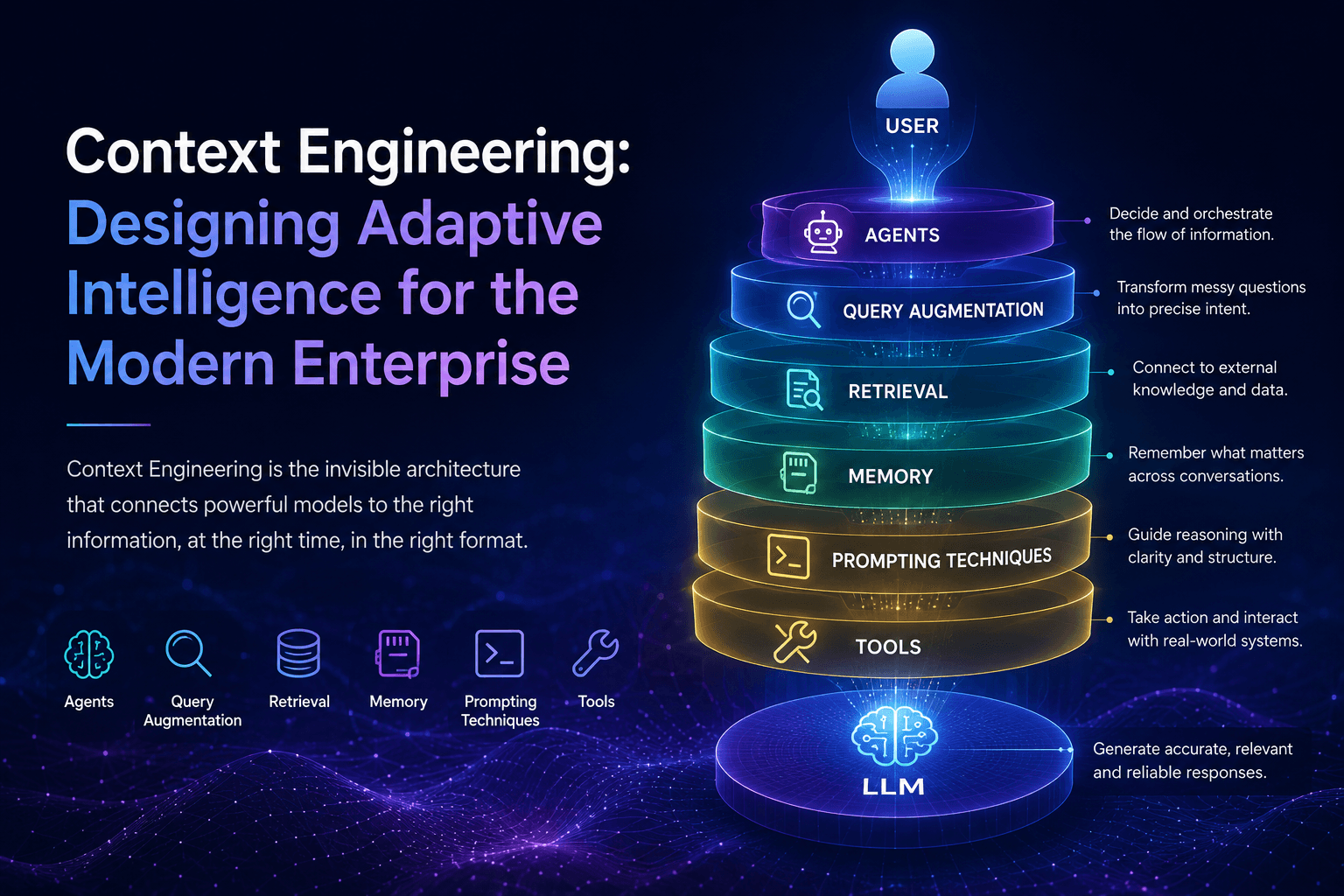
A language model can only work with the information available to it at a given moment. If critical knowledge, user history, organizational data, or real-time information is missing, even the most advanced model will struggle to deliver reliable outcomes. This realization has given rise to an emerging discipline known as Context Engineering—the practice of designing systems that ensure AI receives the right information, at the right time, and in the right format.
As AI adoption accelerates across industries, Context Engineering is becoming one of the most important factors separating successful deployments from disappointing experiments. Understanding how context shapes intelligence may ultimately prove just as important as understanding the models themselves.
Table of Contents
The Hidden Problem Behind Most AI Failures
Imagine hiring the world’s most intelligent consultant—someone capable of analyzing complex information instantly and communicating with remarkable clarity. Now place that consultant in a room with no access to company documents, no internet connection, no memory of previous meetings, and no understanding of the people they are helping. Despite their extraordinary intelligence, their usefulness would be severely limited because critical context is missing.
This scenario closely mirrors how modern Large Language Models operate. Models such as GPT, Claude, and Gemini possess exceptional reasoning capabilities, yet they can only work with the information available within their context window. Without access to relevant data, organizational knowledge, or historical interactions, even the most advanced models struggle to deliver consistently accurate and meaningful results.

Enter Context Engineering
Context Engineering is the discipline of designing systems that provide AI models with the right information, at the right time, and in the right format. While much of the AI industry remains focused on building increasingly powerful models, Context Engineering approaches the problem from a different perspective. The goal is not necessarily to make the model smarter, but to make it better informed.
This distinction may seem subtle, yet it fundamentally changes how intelligent systems are designed. Traditional AI thinking often revolves around a single question: “How can we improve the model?” Context Engineering, however, asks a different question: “How can we improve the environment surrounding the model?” This shift moves the focus away from raw computational capability and toward the quality, relevance, and accessibility of information.
Rather than treating artificial intelligence as a standalone component, Context Engineering views intelligence as an ecosystem composed of multiple interconnected layers. The language model itself becomes only one part of a broader architecture that includes memory systems, retrieval pipelines, decision-making agents, external tools, query transformation mechanisms, and structured prompting frameworks.
Together, these components create an environment where intelligence can operate more effectively. Instead of relying solely on what was learned during training, the system can access relevant knowledge, recall important information, interact with external resources, and adapt its responses based on changing circumstances. In many ways, Context Engineering transforms AI from an isolated reasoning engine into a context-aware system capable of delivering more accurate, relevant, and reliable outcomes.
The Whiteboard Problem
Why do even the most advanced AI models sometimes forget important details during long conversations? The answer lies in a fundamental limitation known as the context window. A useful way to understand this challenge is through a simple analogy: imagine the model’s context window as a whiteboard where everything needed for the current task must fit within a limited space.
Every instruction, conversation history, retrieved document, tool output, user request, and reasoning trace competes for space on this whiteboard. As new information is added, older information must eventually be removed or compressed. This creates familiar challenges that many AI users have already experienced, including forgotten conversation details, repeated questions, inconsistent responses, and decisions based on incomplete information.
To address this limitation, many organizations initially focus on increasing context capacity by using larger context windows, additional memory layers, or models capable of processing more tokens. While these approaches can be helpful, they do not completely solve the underlying problem. A larger whiteboard simply allows more information to be displayed—it does not guarantee that the most relevant information receives the model’s attention.
In fact, excessively large contexts can introduce a new set of challenges. As the amount of information grows, models may experience context confusion, information overload, retrieval inaccuracies, increased hallucinations, and higher computational costs. In such situations, the system often struggles to distinguish between critical information and background noise.
This is why the real challenge is not adding more information, but managing information more intelligently. Effective AI systems must continuously decide what information to keep, what to summarize, what to retrieve, and what to discard. That process of selecting, organizing, and delivering the right information at the right moment lies at the heart of Context Engineering.

The Six Pillars of Context Engineering
If Context Engineering is the foundation of modern AI systems, then these six pillars are the building blocks that make it work. Individually, each pillar solves a specific challenge. Together, they help transform a language model from a standalone text generator into a system that can understand context, access information, remember important details, and take meaningful action.
1. Agents — The Decision Makers
Imagine assigning a complex task to an employee without allowing them to make decisions. They would simply follow instructions step by step, even when circumstances change. Early AI systems behaved in a similar way. They could follow prompts, but they struggled to adapt when new information appeared or when unexpected situations emerged.
This is where agents play an important role. Agents act like project managers within an AI system. They constantly evaluate the situation, determine what information is missing, decide which resources should be used, and identify the next best step. Instead of blindly following instructions, they help the system think through a problem and adjust its approach when necessary.
2. Query Enhancement — Understanding What People Really Mean
Humans rarely ask perfect questions. We often provide incomplete information, use vague language, or assume the other person understands our intent. For example, someone might simply ask, “Why isn’t my API working?” While the question makes sense to a human colleague, an AI system may need additional context to understand what kind of problem is being described.
A well-designed Context Engineering system helps bridge this gap by expanding or clarifying the request behind the scenes. Rather than focusing only on the exact words typed by the user, the system attempts to understand the intent behind the question. This significantly improves the chances of finding relevant information and delivering a useful answer.
3. Retrieval — Connecting AI to Knowledge
One common misconception about AI is that it should already know everything. In reality, no language model can continuously memorize every company document, policy update, research paper, customer record, or product specification.
Instead, modern AI systems work much like experienced professionals. When they need information, they look it up. Retrieval allows AI systems to search trusted sources and bring relevant information into the conversation only when it is needed. This could include internal documentation, research articles, customer support records, knowledge bases, or operational guidelines.
The result is an AI system that stays current, accurate, and connected to real-world information rather than relying solely on what it learned during training.
4. Memory — Learning from Previous Interactions
One of the earliest frustrations with AI systems was their inability to remember. Every interaction felt like a first meeting. Users had to repeatedly explain preferences, goals, and previous discussions because the system had no sense of continuity.
Humans build understanding through experience. We remember previous conversations, learn from past mistakes, and gradually develop context about the people we interact with. For AI systems to become useful long-term assistants, they need a similar capability.
This is where memory becomes essential. A modern AI system typically operates with multiple layers of memory.
Short-Term Memory contains the information currently inside the context window. It is the AI’s active workspace, holding recent conversation history, instructions, retrieved documents, and ongoing reasoning.
Long-Term Memory stores information outside the context window. This may include user preferences, organizational knowledge, previous interactions, or domain-specific expertise stored in vector databases and knowledge repositories.
Working Memory acts as a temporary scratchpad for complex tasks. When planning a trip, analyzing a dataset, or conducting multi-step research, the system uses working memory to track progress without overwhelming the active context window.
The goal is not to remember everything. In fact, excessive memory can create new problems by cluttering the system with outdated, duplicated, or irrelevant information. The most effective AI systems are not those that remember the most—they are the ones that remember what truly matters.
5. Tools — Moving Beyond Conversation
Consider a simple question such as, “What’s the weather in Tokyo right now?” Without access to external resources, an AI model can only make an educated guess. However, if the system can access a weather service, it can provide an accurate and up-to-date answer.
Now imagine asking the same AI to compare flight prices, check hotel availability, schedule meetings, send emails, or analyze a spreadsheet. These tasks require more than conversation—they require action.
Tools give AI systems the ability to interact with the outside world. They can connect to search engines, databases, calendars, business applications, financial systems, and countless other services. Instead of simply talking about information, the AI can actively retrieve, process, and use it to complete tasks.
As organizations continue integrating AI into everyday operations, this capability is becoming increasingly important. The future of AI is not about knowing everything. It is about knowing how to find and use the information that matters.
As these integrations grow, businesses face another challenge: connecting dozens of different systems efficiently. This is why new standards such as the Model Context Protocol (MCP) are gaining attention. Think of MCP as a universal connector that allows AI systems to communicate with different applications through a common framework. Rather than building countless custom connections, organizations can create scalable ecosystems where information flows more easily between tools, platforms, and intelligent agents.

6. Context Hygiene — Keeping Information Clean and Useful
One of the most overlooked aspects of Context Engineering is something surprisingly simple: keeping information organized. As AI systems become more capable, they continuously collect information from conversations, memories, documents, databases, and external tools. Over time, this information can grow into a massive pool of context that the system must navigate every time it generates a response.
Imagine working at a desk covered with old reports, duplicate notes, outdated instructions, and conflicting documents. Even if all the information is technically available, finding the right piece at the right moment becomes increasingly difficult. AI systems face a similar challenge. The problem is often not a lack of information—it is having too much information competing for attention.
As systems scale, four common problems begin to emerge.
The first is Context Poisoning, where incorrect information enters the system and gets reused repeatedly. A small mistake can gradually spread through future responses, turning a minor error into a persistent problem.
The second is Context Distraction. When too much irrelevant information is present, the system may focus on details that have little to do with the task at hand. As a result, responses become less precise and less useful.
The third challenge is Context Confusion. This occurs when different instructions, documents, or sources provide conflicting information. Faced with multiple versions of the truth, the system struggles to determine which one should guide its response.
Finally, there is Context Clash, where several pieces of information compete simultaneously for importance. In these situations, the AI may find it difficult to prioritize the most reliable or relevant source, leading to inconsistent outcomes.
These challenges become increasingly common as organizations connect AI systems to larger knowledge bases, more tools, and longer conversation histories. Simply adding more information does not guarantee better results. In many cases, it can make decision-making more difficult.
This is why modern AI systems invest heavily in techniques that keep context clean and relevant. They summarize lengthy information, remove outdated details, retrieve only what is needed, filter out noise, and validate the reliability of different sources before presenting them to the model.
Ultimately, the objective is simple: deliver the highest-quality information with the least amount of unnecessary noise. In many ways, Context Engineering is not just about providing more context—it is about providing better context.
The Next Evolution: Tool Ecosystems and MCP
As organizations deploy increasingly sophisticated AI systems, a new challenge begins to emerge. It is no longer enough for AI to access a single database or connect to one external application. Modern enterprises operate across dozens of platforms, each containing valuable information that may be needed to complete a task.
Customer relationship management systems, enterprise resource planning platforms, knowledge repositories, email services, cloud storage environments, project management tools, and analytics platforms all contain pieces of the broader organizational context. Connecting AI systems to each of these applications individually can quickly become difficult, expensive, and difficult to maintain.
This challenge is driving the rise of tool ecosystems and integration standards such as the Model Context Protocol (MCP). Think of MCP as a universal communication layer that allows AI systems to interact with different tools and services through a common interface. Rather than creating hundreds of custom integrations, organizations can expose capabilities in a standardized way that compatible AI systems can understand and use.
The significance of this shift extends beyond technical convenience. It represents a move away from isolated AI assistants toward interconnected intelligence ecosystems. Instead of operating as standalone applications, future AI systems will be able to access information, coordinate actions, and collaborate across multiple platforms more seamlessly than ever before.
In many ways, MCP represents the next logical step in Context Engineering. Once organizations learn how to provide AI with the right context, the next challenge becomes ensuring that context can flow efficiently across an increasingly complex digital environment. The future of AI will not be defined by a single model or a single tool, but by ecosystems where information, tools, and intelligent agents work together as a unified system.
Why Context Engineering Matters for Enterprises
When organizations evaluate AI initiatives, the conversation often begins with model selection. Should we use GPT, Claude, Gemini, or an open-source alternative? While these decisions are certainly important, they are rarely the primary factor that determines whether an AI project succeeds or fails.
In practice, two organizations can deploy the exact same model and achieve dramatically different outcomes. The difference usually lies not in the model itself, but in the surrounding ecosystem. The quality of information available to the model, the way knowledge is retrieved, the tools it can access, and the memory it maintains often have a far greater impact on performance than the choice of model alone.
Consider a customer support application. A basic implementation may rely entirely on the model’s training data, resulting in generic responses that lack awareness of company policies, product updates, or customer history. As a result, answers may be inconsistent, incomplete, or disconnected from the customer’s actual situation.
A context-engineered implementation works very differently. It can retrieve the latest support documentation, access customer records, reference organizational policies, remember previous interactions, and use specialized tools to resolve issues more effectively. The underlying model may be exactly the same, yet the quality of the customer experience improves significantly because the system has access to better context.
This principle extends far beyond customer support. In healthcare, AI systems can assist professionals by accessing patient histories, clinical guidelines, treatment protocols, and medical research. In finance, they can combine market information, regulatory requirements, portfolio data, and risk models to support decision-making. Manufacturing organizations can connect operational procedures, maintenance records, sensor data, and production workflows, while procurement and supply chain teams can integrate supplier information, contracts, inventory levels, forecasts, and sourcing policies.
Across every industry, a common pattern emerges. The most successful AI systems are not necessarily those with the largest models or the most parameters. They are the systems that can access, organize, and utilize the right information when it is needed. In an increasingly competitive landscape, context is rapidly becoming the true differentiator.
The Shift from Prompt Engineers to Context Architects
A few years ago, prompt engineering became one of the most discussed topics in artificial intelligence. Teams experimented with different instructions, carefully refined wording, and searched for the perfect prompt that could consistently produce better results. For many organizations, success seemed to depend on finding the right combination of words.
Prompting remains an important skill, but the industry is gradually recognizing a deeper reality. Even the most carefully crafted prompt cannot compensate for missing, outdated, or inaccurate information. A brilliant instruction operating on poor context will often produce poor outcomes, while a well-informed system can generate valuable results even with relatively simple prompts.
This realization is reshaping how organizations think about AI development. The focus is shifting away from isolated prompt optimization and toward the broader challenge of designing intelligent information environments. Questions such as where information comes from, how it is retrieved, what should be remembered, and which tools should be available are becoming just as important as the prompts themselves.
As a result, a new type of practitioner is emerging: the Context Architect. These professionals look beyond individual prompts and focus on the entire ecosystem surrounding an AI system. They design information flows, retrieval strategies, memory structures, tool integrations, and user experiences that allow intelligence to operate effectively within real-world environments.
The future of AI will not be shaped solely by those who can write the best prompts. It will be shaped by those who can design systems that provide the right information, at the right time, in the right context. As AI continues to evolve, the ability to build and manage these intelligent environments may become one of the most valuable skills in the industry.

The future of AI is not a bigger brain. It is a better context ecosystem.
Final Thoughts: The Future Is Not Bigger Models
Artificial intelligence is entering a new phase of evolution. For much of the last decade, progress was measured through increasingly powerful models, larger datasets, longer context windows, and improved benchmark scores. Each new generation of AI promised greater capabilities, and those advancements have undoubtedly played a critical role in bringing us to where we are today.
However, as organizations move from experimentation to real-world deployment, a new reality is becoming clear. Raw intelligence alone is no longer enough. Even the most advanced models can struggle when they lack access to relevant information, organizational knowledge, historical context, or the tools needed to complete a task effectively.
This is where Context Engineering changes the conversation. Rather than focusing exclusively on making models smarter, it focuses on making them better informed, better connected, and better equipped to operate within dynamic environments. It provides the foundation that allows AI systems to access knowledge, remember important information, collaborate with external tools, and adapt to changing circumstances.
In many ways, Context Engineering serves as the bridge between theoretical intelligence and practical usefulness. It transforms isolated language models into context-aware systems capable of delivering more accurate, relevant, and trustworthy outcomes. As AI continues to become embedded within business operations, research environments, public services, and everyday life, this capability will become increasingly important.
Perhaps the most valuable lesson is also the simplest: intelligence alone rarely guarantees good decisions. Whether human or artificial, the quality of decisions ultimately depends on the quality of the information available at the moment those decisions are made.
The organizations that succeed in the next generation of AI will not necessarily be those with access to the largest models or the biggest computational resources. Instead, they will be the ones that build systems capable of delivering the right information, to the right place, at the right time.
The future of intelligent systems is not just about creating bigger brains. It is about building better context ecosystems. And that is precisely why Context Engineering may become one of the most important disciplines in the age of AI.
Have any thoughts?
Share your reaction or leave a quick response — we’d love to hear what you think!
-
 0
0 - 0
- 0



