
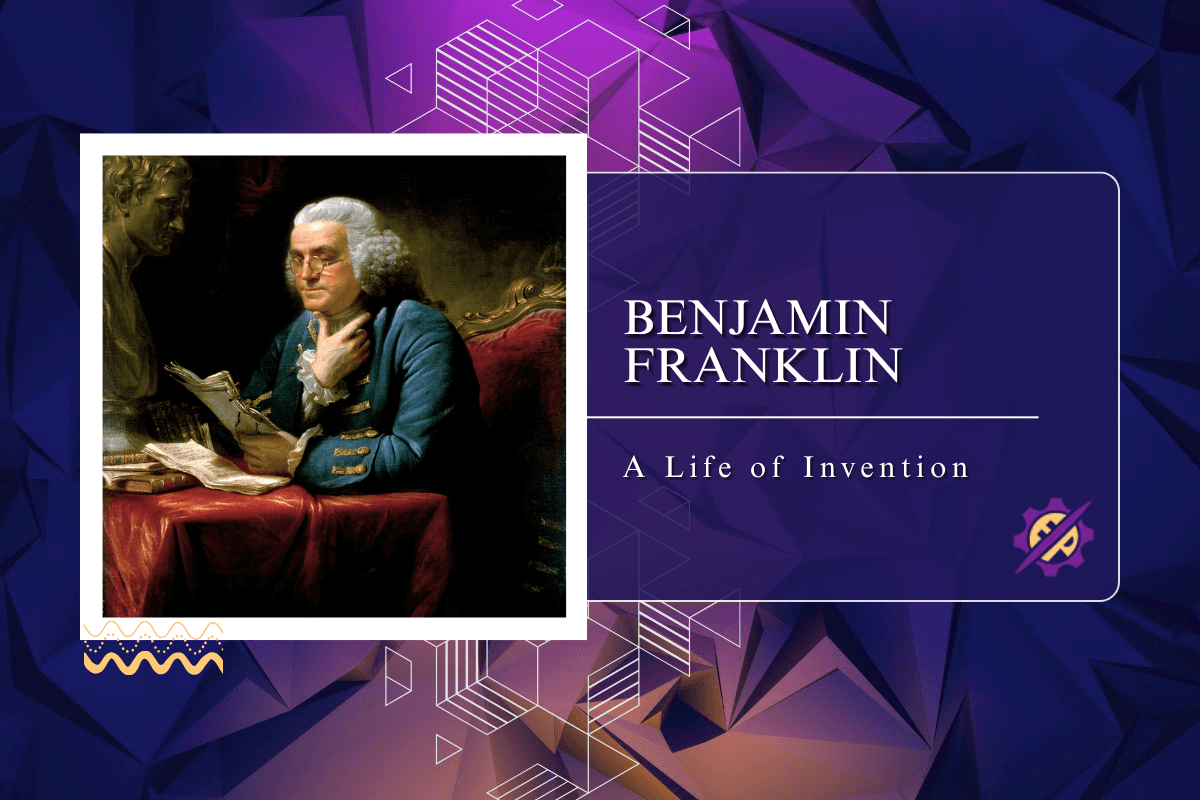
Most people think of Benjamin Franklin as the kite-and-lightning guy. Or maybe the guy on the $100 bill. But Franklin lived 84 years and spent them doing different things. He was a printer, then a scientist, then a politician, then a diplomat, then came back to help write a constitution. He also started institutions that still exist.
He’s the only person who signed the Declaration of Independence, the Treaty of Paris, and the Constitution.
Table of Contents
Printer (age 12-42)
Franklin ran away from Boston at 17 and ended up in Philadelphia with almost nothing. By his mid-twenties, he owned his own print shop. He published the Pennsylvania Gazette and wrote Poor Richard’s Almanack, which made him wealthy through sayings like “Early to bed, early to rise” and “A penny saved is a penny earned.”
He retired from printing at 42.
Scientist (age 40-60)
Benjamin Franklin didn’t discover electricity. People had been experimenting with static electricity for decades. What Franklin figured out was that lightning was the same thing as the sparks from a Leyden jar, just much bigger.
His kite experiment in 1752 proved this. A metal key attached to the kite string drew sparks from storm clouds. A French scientist actually did a similar experiment a month earlier using an iron rod. But Franklin got the credit, partly because he was already famous and partly because he was better at publicity.
From the lightning work came the lightning rod. Before Franklin, churches burned down regularly because they were the tallest buildings in town and attracted strikes. The fix was simple: pointed iron rod on the roof, wire running down the building, connection to the ground.
Franklin also coined the electrical terms we still use: battery, positive, negative, charge, conductor.
What He Invented

- Swim fins (1717): Wooden paddles for hands, invented when he was 11
- Franklin stove (1741): Cast-iron fireplace insert, more heat with less wood, less smoke
- Lightning rod (1752): Iron rod on roof, wire to ground, diverts lightning strikes
- Flexible catheter (1752): For his brother who had kidney stones, made of hinged silver segments
- Glass armonica (1762): Musical instrument using spinning glass bowls
- Bifocals (1784): Two lens strengths in one pair of glasses, distance on top, reading on bottom
- Long arm (1786): Grabber pole for reaching books on high shelves
He never patented any of them. He thought inventions should benefit everyone.
What He Founded
| Year | Institution | Still exists? |
|---|---|---|
| 1731 | Library Company of Philadelphia (first lending library in America) | Yes |
| 1736 | Union Fire Company (first volunteer fire department) | Evolved into Philadelphia Fire Department |
| 1743 | American Philosophical Society (scientific organization) | Yes |
| 1749 | Academy of Philadelphia (became University of Pennsylvania) | Yes |
| 1751 | Pennsylvania Hospital (first public hospital in America) | Yes |
| 1752 | Philadelphia Contributionship (first fire insurance company) | Yes |
Beyond these institutions, Franklin organized Philadelphia’s first street cleaning and street lighting programs and reformed the colonial postal system as Deputy Postmaster.
Politician and Diplomat (age 42-79)
Franklin represented Pennsylvania in London for almost 20 years, trying to negotiate with Parliament. When that failed and the Revolution started, he went to France. He wore a fur cap instead of a wig, which the French took as a sign of New World simplicity. He convinced France to send money, troops, and ships to support the Revolution.
After the Treaty of Paris ended the war in 1783, Franklin came home. He was 79.
Final Years (age 79-84)
Franklin served as president of Pennsylvania (basically governor) for three years. At 81, he was a delegate to the Constitutional Convention. He was too weak to stand and give speeches, so he wrote out his remarks and had someone else read them.
His last public act was signing a petition to Congress calling for the abolition of slavery. He had owned slaves earlier in his life. By the end, he was president of an abolitionist society.
He died in 1790 at 84. About 20,000 people attended his funeral in Philadelphia. The city’s population at the time was 28,000.
For interesting engineering and science content, follow our Instagram page!
Have any thoughts?
Share your reaction or leave a quick response — we’d love to hear what you think!
-
 0
0 - 0
- 0



