
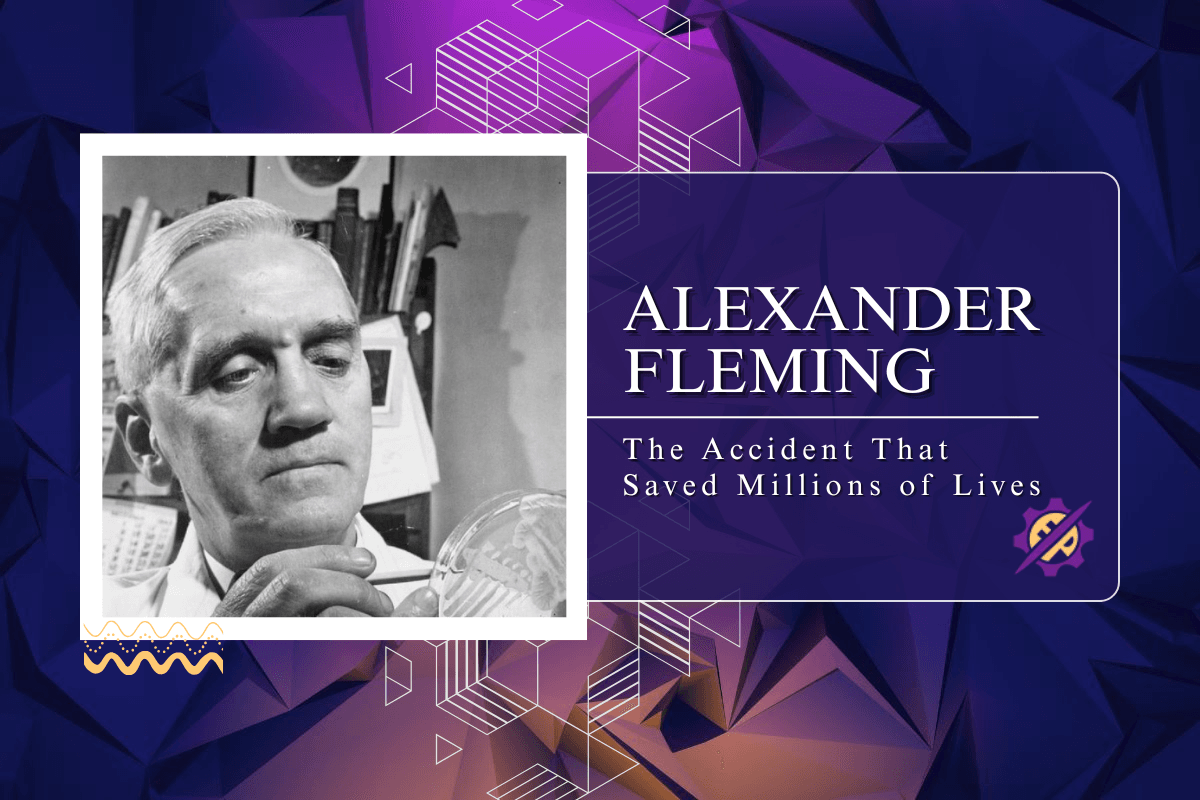
In September 1928, Alexander Fleming returned from vacation to find mold growing on a petri dish he had left out. The bacteria around the mold were dead. Most scientists would have thrown it away. Fleming didn’t.
That contaminated dish led to penicillin, the first antibiotic.
“One sometimes finds what one is not looking for.” – Alexander Fleming
Table of Contents
Infection Before Antibiotics
Before antibiotics, a small cut could kill you. Surgeons could remove a bullet, set a bone, or take out an appendix, but they couldn’t stop the infections that followed. Hospitals were full of patients dying from sepsis, gangrene, and pneumonia. Doctors could only watch.
Fleming saw this during World War I. He worked as a military doctor in France, treating wounded soldiers. Men survived their injuries only to die days later from infected wounds. The antiseptics available at the time often did more harm than good, damaging healthy tissue while failing to kill bacteria deep in wounds.
After the war, Fleming went back to St. Mary’s Hospital in London.
September 1928
Fleming was studying staphylococcus bacteria when he left for a two-week holiday. When he came back, he noticed something odd. A petri dish near an open window had been contaminated by mold spores. Around the mold, the staph bacteria had dissolved.
He could have cleaned up and started over. Instead, he investigated.
The mold was Penicillium notatum. Fleming found that it produced a substance that killed bacteria without harming human tissue. He called it penicillin.
“I did not invent penicillin. Nature did that. I only discovered it by accident.” – Alexander Fleming
Why It Took 12 Years
Fleming published his findings in 1929. Almost nobody noticed.
The problem was that Fleming was a researcher, not a chemist. He couldn’t figure out how to produce penicillin in large enough quantities to be useful, or how to purify it so it could be given to patients. He mentioned it in lectures occasionally, but mostly moved on to other projects.
Penicillin sat on the shelf for over a decade.
| Year | What Happened |
|---|---|
| 1929 | Fleming publishes his findings in the British Journal of Experimental Pathology |
| 1938 | Howard Florey and Ernst Boris Chain at Oxford read Fleming’s paper and revisit penicillin |
| 1940 | Florey and Chain successfully purify penicillin and test it on mice |
| 1941 | First human trials begin |
| 1942 | American pharmaceutical companies begin mass production |
| 1944 | 2.3 million doses ready for D-Day |
Florey, Chain, and Mass Production

Fleming discovered penicillin. Florey and Chain made it usable.
Howard Florey was an Australian pathologist. Ernst Boris Chain was a German-Jewish biochemist who had fled Nazi Germany. Together at Oxford, they assembled a team to tackle the chemistry Fleming couldn’t crack.
The work involved:
- Extracting and purifying the compound from mold
- Testing it on animals, then humans
- Growing mold in hundreds of bedpans, ceramic vessels, and bathtubs
- Convincing American drug companies to scale up production
When Britain couldn’t produce enough during wartime, Florey traveled to the United States. By 1944, American factories were producing enough penicillin for Allied troops on D-Day.
All three men shared the Nobel Prize in Physiology or Medicine in 1945.
“Penicillin cures, but wine makes people happy.” – Alexander Fleming
What Penicillin Changed
| Before Penicillin | After Penicillin |
|---|---|
| Pneumonia killed 30-40% of hospitalized patients | Death rate dropped below 10% |
| Wound infections were often fatal in war | Mortality from infected wounds fell sharply |
| Syphilis required years of toxic treatment | Curable in days |
| Minor surgeries carried serious infection risk | Routine procedures became safer |
Scarlet fever, strep throat, bacterial meningitis, infected wounds. Doctors finally had something that worked.
Fleming’s Warning
Fleming became famous. Florey and Chain, who did the work of turning penicillin into a usable drug, were largely forgotten by the public.
Fleming received the Nobel Prize, a knighthood, and honors from around the world. He was modest about his role, often pointing out that luck played a large part. But he also warned repeatedly about overusing antibiotics.
In a 1945 interview with the New York Times, he said:
“The thoughtless person playing with penicillin treatment is morally responsible for the death of the man who succumbs to infection with the penicillin-resistant organism.” – Alexander Fleming
He saw the problem coming. Bacteria evolve. The more antibiotics are used, the faster they adapt.
What Happened Next
Fleming died in 1955. By then, antibiotic-resistant bacteria were already appearing.
Today, antibiotic resistance is one of the biggest threats to global health. The World Health Organization calls it a crisis. Bacteria that resist every available drug are spreading. Procedures that became routine after penicillin, like hip replacements and chemotherapy, could become dangerous again if antibiotics stop working.
Fleming’s accident in 1928 gave doctors a way to fight infections. The rest of the story is still being written.
For interesting engineering and science content, follow our Instagram page!
Have any thoughts?
Share your reaction or leave a quick response — we’d love to hear what you think!
-
 0
0 - 0
- 0



